
Traveling from Newark Liberty International Airport (EWR) to Scarsdale looks deceptively simple on a map. Roughly 35–40 miles, a straight line north-east, and you are “almost there.”
In practice, this route is one of the most logistically fragile airport transfers in the New York tri-state area. The challenge is not distance it is accumulated friction: crossing state lines, navigating toll authorities and congestion zones, handling multiple transfers if you avoid the car, and dealing with a surprisingly weak last-mile connection once you reach Scarsdale.
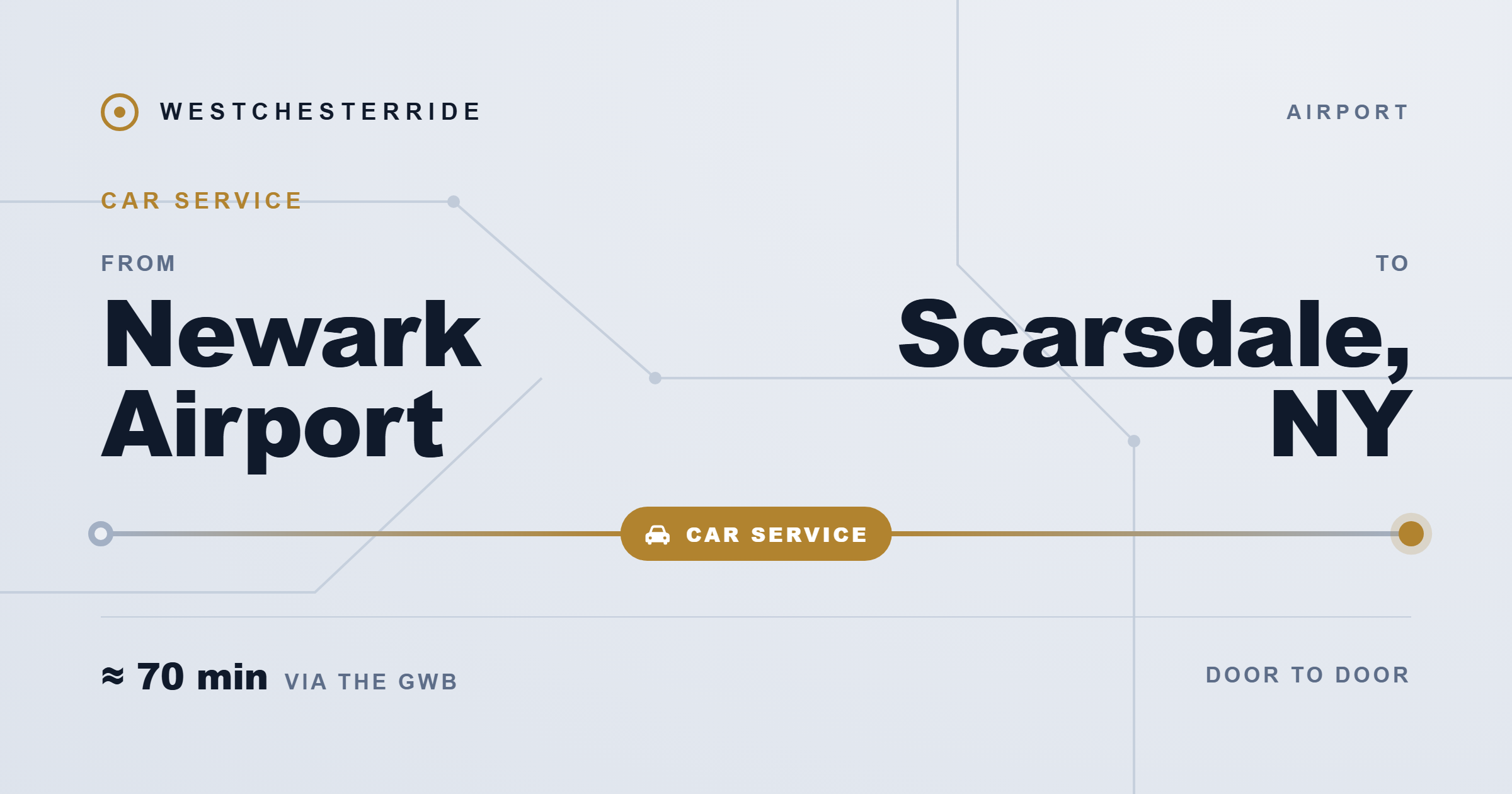
This guide breaks down why Newark → Scarsdale requires more planning than it seems, how each transport option behaves in the real world, and which traveler profiles are most affected.
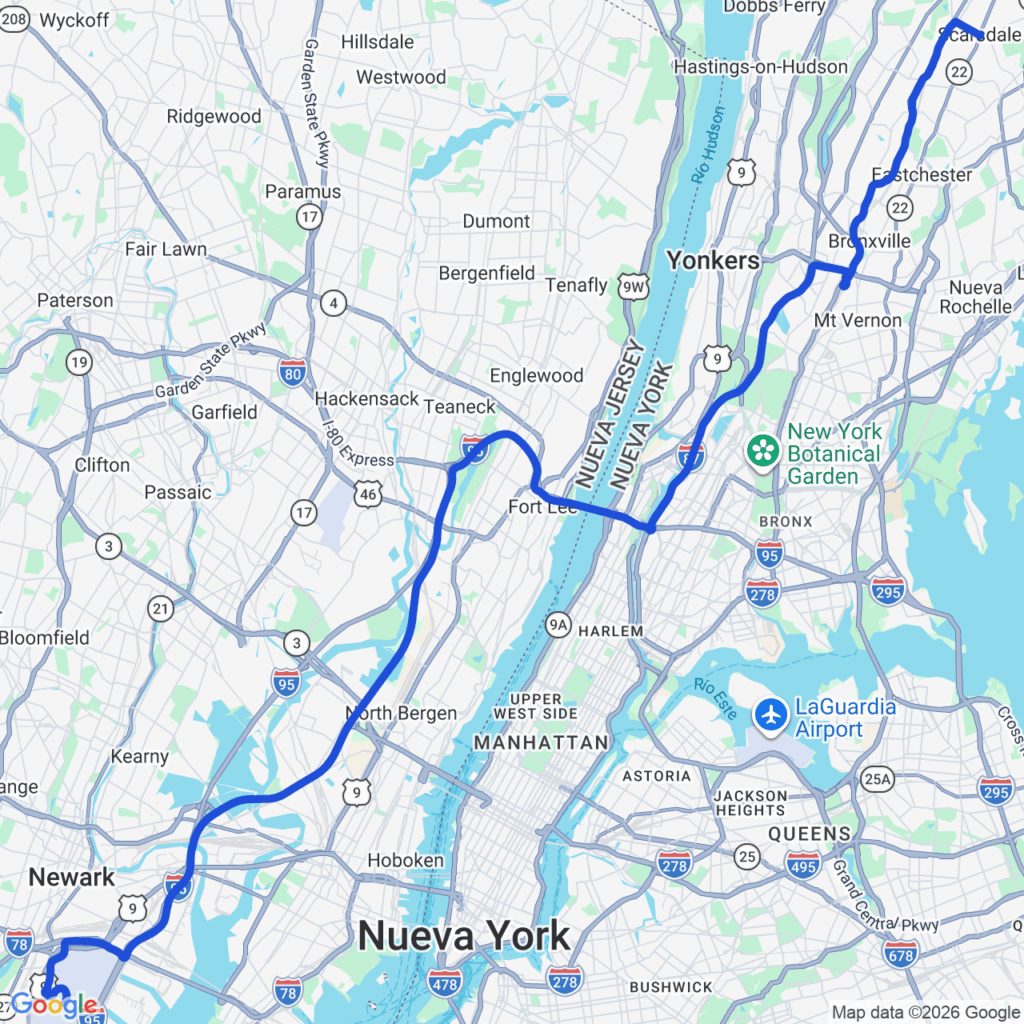
Understanding the route from Newark to Scarsdale
The EWR–Scarsdale corridor is interstate, inter-agency, and multimodal by default. A typical journey must cross:
- New Jersey → New York State
- At least one Hudson River crossing (bridge or tunnel)
- One of the most congested urban corridors in the U.S. (Manhattan or the Bronx)
- A final suburban segment with limited late-night mobility
What turns a “35-mile trip” into a planning problem is not mileage but sequence. Each segment has its own failure points, and delays compound rather than cancel out.
Data-backed insight: how airport routes actually perform
If you want to understand how this route compares to the full system, including variability, peak-hour behavior, and reliability differences between airports, see the full airport transportation study.
What is the best way to get from Newark Airport to Scarsdale?
The most reliable way to get from Newark Airport to Scarsdale is a pre-booked private car service, which typically costs $200–$320 (reference range) and takes 70–100 minutes depending on traffic. For lower cost and daytime travel without heavy luggage, a train combination via Penn Station and Grand Central can work, but total travel time often reaches 2–3 hours and requires multiple transfers.
Timing reality:
- In optimal conditions: ~65–75 minutes by car
- In peak traffic or incidents: 120–180 minutes is common
Prices and times mentioned throughout this article are indicative estimates only, provided for planning context. Actual costs and durations vary by provider, traffic, weather, and time of day.
Comparison: train vs taxi vs rideshare vs private car
| Mode | Typical cost (reference) | Travel time range | Best for |
|---|---|---|---|
| Train (AirTrain + NJ Transit + subway + Metro-North) | $32–$45 per person | 1h 50m – 2h 45m | Solo travelers, light luggage |
| Uber / Lyft | $150–$260+ | 75–150 min | Flexible schedules, off-peak |
| Taxi | $180–$280+ | 75–150 min | Travelers avoiding apps |
| Private car service | $200–$320+ | 70–100 min | Families, international arrivals |
| Bus | Not practical | Not applicable | Not recommended |
Fares and travel times on this page are 2026 estimates and can change with the season, schedule updates, demand, weather, and service conditions. Confirm current prices and times with the official carrier before you travel.
Why the map lies: distance vs complexity
Many travelers assume Newark is “just across the river.” That assumption ignores three structural multipliers:
- Interstate friction
Crossing from NJ into NY activates multiple toll systems and traffic authorities. What looks like one road on a map is, operationally, several systems stitched together. - Hudson River bottlenecks
The George Washington Bridge, Lincoln Tunnel, and Holland Tunnel are predictable choke points. A minor incident can double travel time with no viable detour. - Last-mile fragility in Scarsdale
Even after reaching Scarsdale by train, local taxi and rideshare availability especially late at night is inconsistent.
Option 1: train (the multimodal route)
How it works
- AirTrain EWR → Newark Airport Rail Station
- NJ Transit → New York Penn Station
- Subway or short taxi → Grand Central Terminal
- Metro-North Harlem Line → Scarsdale
What looks good on paper
- Lower out-of-pocket cost
- Avoids tolls and surge pricing
- Reliable rail infrastructure within each segment
Where it breaks down
- Penn Station → Grand Central is the weakest link
No direct rail connection. Navigating Midtown with luggage adds time and stress. - Transfer penalties stack
Missing a Metro-North train by two minutes can mean a 30-minute wait. - Luggage friction
NJ Transit and Metro-North are commuter systems, not luggage-friendly designs.
When this option is not recommended:
- Traveling with children or multiple suitcases
- Late-night arrivals
- After long international flights
Option 2: Uber or Lyft
What to expect
Rideshare pricing from EWR to Scarsdale is highly variable. A quote at landing may look reasonable and increase significantly once you exit the terminal or traffic builds.
Variables that affect price and time:
- Weather
- Time of day
- Demand spikes at EWR
- Hudson crossing conditions
- NYC congestion pricing zones
Operational reality
Drivers often factor the empty return trip back into pricing, since they may not legally pick up a passenger in Westchester on the way back.
When this option is not recommended:
- Tight schedules
- Budget certainty required
- Peak hours (late afternoon, early evening)
Option 3: taxi
Traditional taxis remove app dependency but do not remove interstate complexity. Metered or flat-rate pricing still absorbs:
- Airport access fees
- Toll crossings
- Congestion surcharges
Availability at Newark is usually good, but cost predictability is limited unless pre-arranged.
When this option is not recommended:
- Travelers sensitive to variable pricing
- Long delays likely (rush hour, weather events)
Option 4: private car service
This is the most predictable option, especially for families and international travelers.
Why it works better
- Flat-rate pricing (reference ranges disclosed upfront)
- Drivers familiar with which Hudson crossing to choose
- No transfer points
- Direct door-to-door service in Scarsdale
Trade-off
Higher upfront cost, but fewer failure points.
When this option is not recommended:
- Solo travelers prioritizing lowest cost
- Very flexible schedules with minimal luggage
The hidden problem: the last mile in Scarsdale
Arriving at Scarsdale station does not guarantee a smooth finish.
Key issues
- Reduced local taxi fleets compared to pre-pandemic years
- Rideshare availability drops after ~9–10 PM
- Station layout requires elevators or stairs, which adds friction with luggage
For residents returning late at night, this last segment often becomes the most stressful part of the journey.
How Newark compares with other airports to Scarsdale
| Airport | Distance | Complexity | Main advantage | Main drawback |
|---|---|---|---|---|
| HPN | 10–15 mi | Low | Proximity | Limited routes |
| LGA | 20–25 mi | Medium | Closer, NY-side | Traffic sensitive |
| JFK | 30–35 mi | High | International hub | Van Wyck congestion |
| Newark (EWR) | 35–40 mi | Very high | United hub | Interstate friction |
Compared with John F. Kennedy International Airport or LaGuardia Airport, Newark’s defining problem is not length but jurisdictional sequencing. JFK and LGA are chaotic, but they stay on the New York side of the system.
For related context, see:
- JFK to Scarsdale transportation
- LaGuardia to Scarsdale transportation
- Planning transportation from Westchester County to Newark Airport
Who feels this friction the most?
Families
- Low tolerance for transfers
- High luggage volume
- Strong need for child seats and predictability
International travelers
- Fatigue amplifies navigation errors
- Language barriers make Penn Station and Midtown transfers harder
Returning residents
- Value predictability over novelty
- Most critical of delays after long flights
Local insider tips for this route
- Avoid landing at EWR between 3:30–6:30 PM if possible
- Check traffic before leaving the terminal, not before landing
- If using trains, pre-buy tickets and study Penn Station exits in advance
- For late arrivals, pre-arrange the Scarsdale last mile
These realities contrast sharply with routes like White Plains to JFK, where distance is longer but system exposure is more stable.
How this route performs by time of day
To move beyond structural theory, a predictable time-of-day pattern describes how the Newark → Scarsdale corridor performs under real-world conditions.
The data confirms that this route operates on a consistently high time baseline, with sharp congestion amplification during commuter windows.
Time-of-day performance
Early morning departures averaged approximately 54 minutes, indicating that even under low-traffic conditions the trip rarely falls below one hour door-to-door.
Morning commuter hours (5 AM–10 AM) increased average duration to more than 63 minutes.
Midday travel averaged roughly 60 minutes, reflecting sustained baseline friction even outside peak congestion.
The most volatile window occurred between 3 PM and 7 PM, when average duration approached 68 minutes and congestion added nearly 13 minutes beyond baseline conditions.
After 7 PM, travel times stabilized but remained close to one hour on average.
Weekday vs weekend behavior
On weekdays, the route averaged nearly 63 minutes.
On weekends, average duration dropped to approximately 56 minutes, confirming that commuter traffic and interstate crossings are the dominant stress multipliers.
Most critical departure hours
The slowest hours recorded were 7–8 AM and 4–6 PM, where average travel time exceeded 70 minutes. These windows represent the highest delay sensitivity and the lowest recovery flexibility.
Strategic takeaway
For Scarsdale-bound travelers, Newark introduces not only distance but structural compounding risk. Even small delays during commuter hours cascade quickly due to interstate exposure and corridor sequencing. Buffer planning is not optional for weekday arrivals.
Data based on structured multi-day monitoring. Travel times are averages and may vary due to weather, incidents, or demand conditions.
Related guides
You may also find useful:
- Transportation options in Westchester County
- Taxi vs rideshare in Westchester County
- Early morning airport transportation in Westchester
Frequently asked questions
Plan for 2.5–3 hours total travel time from landing to arrival in Scarsdale.
Only when route availability or pricing significantly outweighs added ground-travel friction.
Technically yes, practically challenging during peak commuter hours.
Final takeaway
The Newark → Scarsdale journey is not difficult because it is long. It is difficult because each segment introduces risk, and those risks compound. Planning rather than improvisation is what separates a manageable trip from a draining one.





