JFK to Newark is about 21 miles as the crow flies, and that number is the trap. The two airports sit in different states, with Manhattan and the Hudson River wedged between them, so the trip crosses two of the busiest transportation systems in North America to cover a distance that looks trivial on a map. It is one of the most complex airport transfers in the region, not because it is long but because the Hudson crossing and the multi-system rail chain make the time wildly variable. A car can do it in 40 minutes in light traffic or take over two hours at rush. For anyone connecting between flights, the real planning number is not the distance but the buffer, and this guide explains why the crossing dominates, what each option really costs, and how much connection time you actually need.
Quick answer
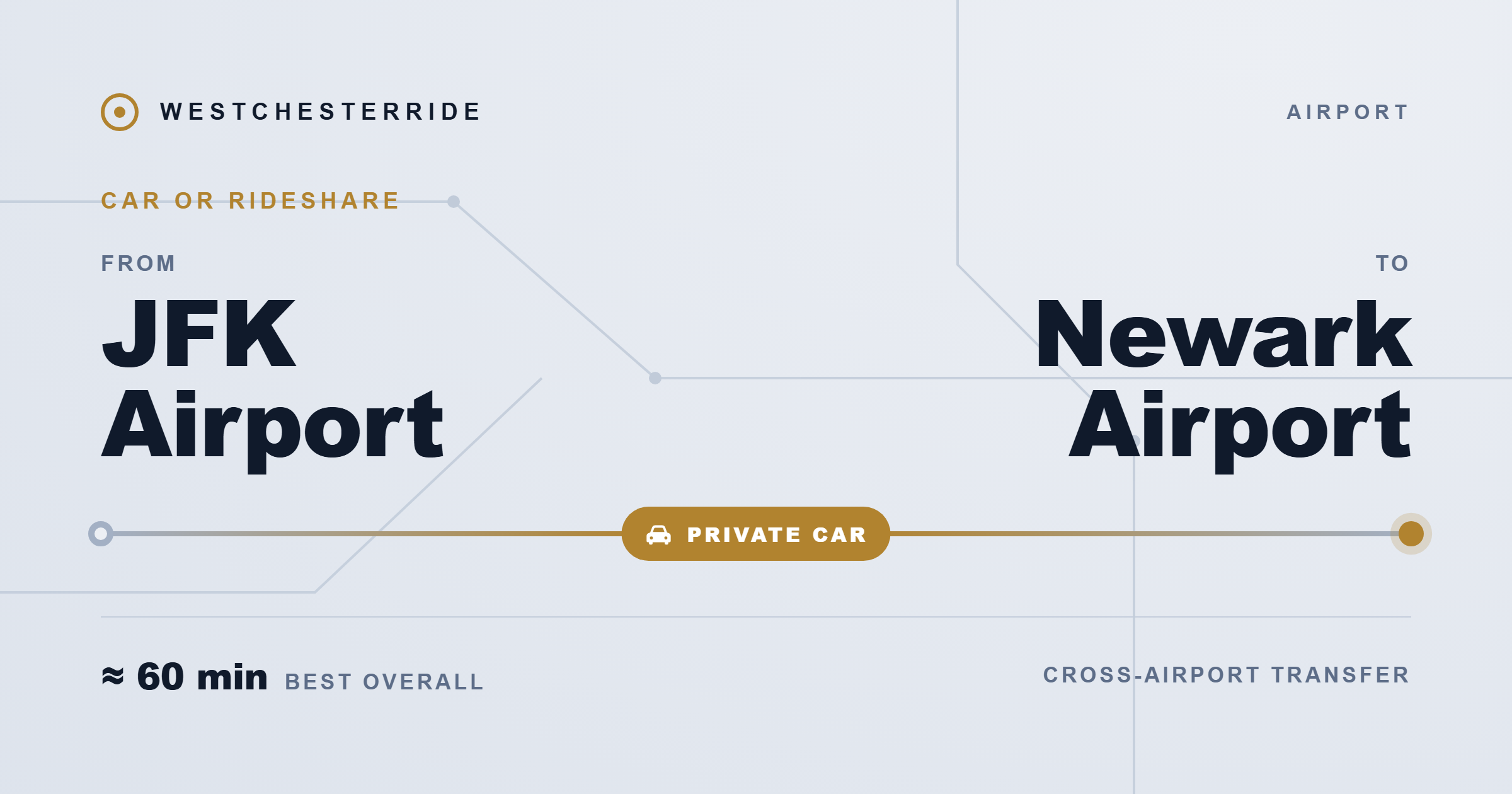
- Best overall: A pre-booked private car or scheduled rideshare, quoted at booking rather than published, 60 to 90 minutes door to door.
- Cheapest: AirTrain plus the LIRR and NJ Transit, $30 to $40, but 90 to 120 minutes with transfers.
- Fastest in light traffic: A taxi or private car at 40 to 60 minutes, though congestion often erases that.
- The real number: The connection buffer, at least 4 hours, because the Hudson crossing makes the time unpredictable.
| Mode | Reference price | Travel time | Best for |
|---|---|---|---|
| Private car service | quoted at booking | 60-110 min | Scheduled transfers |
| Taxi | metered | 60-120 min | Immediate departure |
| Rideshare (Uber/Lyft) | no published fare | 60-120 min | Flexible booking |
| Train (AirTrain + LIRR + NJ Transit) | $30-$40 | 90-120 min | Budget travelers |
| Shared shuttle | $35-$50 | 90-150 min | Low-cost door-to-door |
Fares and travel times on this page are 2026 estimates and can change with the season, schedule updates, demand, weather, and service conditions. Confirm current prices and times with the official carrier before you travel.
Prices are reference bands; the Hudson tunnel crossing moves every figure.
Understanding the two-state transfer
The short distance misleads almost everyone. JFK sits in Queens, New York; Newark operates in Newark, New Jersey; and Manhattan plus the Hudson River sit between them, so most routes cross heavily congested tunnels or interstates. The straight-line distance is about 21 miles, but the driving distance is 27 to 35 depending on route, and the airports comparison frames how differently the region’s airports connect. This is a trip where mileage tells you almost nothing about time.
The Hudson crossing is the heart of the problem. A typical drive runs the Van Wyck to the Belt Parkway or I-278, across the Brooklyn-Queens Expressway, through the Lincoln or Holland Tunnel, and onto the New Jersey Turnpike, and the tunnel is where the delay concentrates. Traffic approaching the Lincoln or Holland Tunnel can extend the trip dramatically at rush hour, which is why the bridges and tunnels guide treats the crossing as the decision that governs the trip.
This complexity is structural, not incidental. Unlike a suburban airport run such as the Newark-from-Westchester route, this connection sits entirely inside the dense urban core, crossing two states and stitching together multiple transit systems. That combination is why the transfer is hard, and why the buffer, not the distance, is the number that matters.
What is the best way to get from JFK to Newark Airport?
The best way to get from JFK to Newark is a private car or rideshare, at a price quoted when you book, in 60 to 90 minutes. The cheapest option is AirTrain plus the LIRR and NJ Transit at $30 to $40, but 90 to 120 minutes with transfers. A taxi is faster in light traffic, but the Hudson crossing makes road time unpredictable.
Typical time by traffic:
Light traffic:
→ 40 to 60 minutes
Normal conditions:
→ 60 to 90 minutes
Rush-hour congestion:
→ 90 to 120+ minutes
The options in detail
Private car and taxi: direct, at a price
A private car service is the most predictable option, because the price is fixed at booking, with a scheduled pickup, fixed pricing, and often flight tracking, which is why travelers use it for early departures or tight connections, much as they do on the county-to-JFK routes. A taxi runs $100 to $160+ once the tunnel toll of roughly $15 to $20, the airport surcharge, and tip are added, direct but exposed to the same traffic. Both skip the transfers entirely, and the taxi-versus-rideshare comparison sorts the road choices.
Edge case: rush-hour departure. In heavy traffic the direct car loses its speed advantage to the tunnel approach, so its value shifts from fast to predictable, which is still worth the premium for a connection.
Rideshare and shared shuttle: flexibility and thrift
A rideshare is easy to book and offers multiple vehicle sizes, though no fare is published in advance and surge pricing at peak can push it above a private car’s fixed quote. A shared shuttle is the low-cost door-to-door choice at $35 to $50 per person, but it collects several passengers before departing, so its 90 to 150 minutes suits only travelers with a loose schedule. Neither is a fit for a tight connection.
Edge case: large luggage. Rideshare requires a larger, pricier vehicle tier for several suitcases, narrowing its cost advantage over a private car on a bag-heavy transfer.
Train: cheapest, with a caveat
Public transit is the lowest-cost option at $30 to $40: AirTrain JFK to Jamaica, the LIRR to Penn Station, NJ Transit to the Newark Airport rail station, and the AirTrain to the terminal. It avoids highway congestion and is relatively predictable in daytime, with frequent departures, and it follows the same regional rail structure the Metro-North lines guide describes. The catch is the transfers and the schedule.
Edge case: late-night transfers. NJ Transit service can pause roughly between 1 a.m. and early morning, so overnight transfers fall back to cars, a constraint the early morning playbook covers. With several large suitcases or an unfamiliarity with New York rail, the train is also not the move.
How much connection time you actually need
Because the travel time varies so widely, the connection buffer is the real planning decision, not the route. Most travelers should allow a minimum of about 4 hours between flights at the two airports, and a safer window is 5 to 6 hours. That may sound excessive for 21 miles, but the Hudson crossing, airport construction, and a missed rail connection can each add an hour without warning, and the travel-time variability analysis shows why the tail is long.
The asymmetry is the point: arriving early at Newark costs you idle time in a terminal, while arriving late costs you the flight. On a transfer this exposed to a single congested crossing, the buffer is not padding but the plan, and it is the number a savvy connecting traveler fixes first, before choosing how to make the trip at all.
Local insider tips for this transfer
Budget the buffer before the route
Decide your connection time first, at least 4 hours and ideally 5 to 6, then pick the mode. On a trip where the same 21 miles can take 40 minutes or over two hours, the buffer is what protects the connection, and choosing a fast-looking option without it is the classic way to miss a Newark flight.
Treat the Hudson tunnel as the wildcard
The Lincoln and Holland Tunnels are where the delay lives, so any road option should assume the crossing, not the highway, is the bottleneck, the same way expressway congestion shapes a road route like JFK to White Plains. In heavy traffic the tunnel approach can add an hour, which is exactly the scenario your buffer exists to absorb.
Use the train in daytime, a car overnight
The rail chain is cheap and reasonably predictable during the day, but NJ Transit’s overnight pause makes it unworkable after roughly 1 a.m. Match the mode to the clock: train for a daytime budget transfer, a pre-booked car for a late-night one, and never assume the last option you used still runs.
Price the taxi honestly
A taxi’s meter is only part of the fare; the tunnel toll, airport surcharge, and tip push a $100 estimate toward $160 or more. Compare the all-in taxi cost against a private car’s fixed rate, because for a transfer this length the fixed price often wins on both certainty and total.
Do not treat this like a short hop
The 21-mile figure invites the mistake of planning a tight connection. This transfer crosses two states and a river through the region’s densest core, so plan it like the complex trip it is, with real buffer, rather than the quick jump the map suggests.
Common failure scenarios
Planning a tight connection on the 21-mile distance:
→ The crossing can turn 40 minutes into two hours
Taking the train after 1 a.m.:
→ NJ Transit’s overnight pause strands the rail chain
Assuming the taxi meter is the full fare:
→ Tolls and surcharges push it toward $160+
Booking a shared shuttle for a tight transfer:
→ Multiple pickups extend it to 90 to 150 minutes
Trusting light-traffic timing at rush hour:
→ The tunnel approach adds an hour without warning
Skipping the buffer to save terminal time:
→ Arriving late costs the flight; early costs minutes
Related guides
The LaGuardia-to-Newark transfer is covered in the LaGuardia to Newark guide. For the wider regional network, see how transportation works in Westchester.
Frequently asked questions
What is the best way to get from JFK to Newark Airport?
For most travelers, a pre-booked private car or scheduled rideshare, priced at booking, for a direct airport-to-airport transfer in 60 to 90 minutes. It offers a scheduled pickup and often flight tracking, which matters for a connection. Public transit is cheaper at $30 to $40 but takes 90 to 120 minutes with several transfers, so it suits budget travelers with time and light luggage.
How long does the JFK to Newark transfer take?
Driving usually takes 60 to 90 minutes, but heavy traffic can extend it to 120 minutes or more, and in light traffic it can drop to 40 to 60. Rail routes typically need 90 to 120 minutes including transfers. The Hudson tunnel crossing is the main variable, which is why the same short distance produces such a wide range of possible times.
How much connection time do I need between JFK and Newark?
Allow a minimum of about 4 hours, and a safer window is 5 to 6 hours. The transfer looks short at 21 miles, but tunnel congestion, airport construction, or a missed rail connection can each add an hour without warning. Because arriving late costs the flight while arriving early costs only terminal time, the larger buffer is the safe choice for a connection.
Is public transit realistic for this connection?
Yes, in daytime and with light luggage. The AirTrain, LIRR, and NJ Transit chain is the cheapest option at $30 to $40 and avoids highway congestion, but it involves several transfers and works best for travelers comfortable with New York rail. It is not recommended for several large suitcases, tight connections, or late-night transfers, when NJ Transit service can pause.
How much does Uber cost from JFK to Newark?
Uber publishes no fare for the trip in advance, and the price it quotes moves with demand, service tier and traffic. Surge pricing during peak periods can push the cost above a private car service’s fixed rate, and larger luggage loads require a pricier vehicle tier. For a scheduled transfer, a pre-booked car often wins on both price certainty and reliability compared with an on-demand rideshare.
Is there a shuttle from JFK to Newark Airport?
Yes. Shared airport shuttles operate between the two airports at roughly $35 to $50 per passenger, offering low-cost door-to-door service. The trade-off is time: shuttles collect multiple passengers before departing, so the trip can run 90 to 150 minutes. That makes them a fit for budget travelers with a flexible schedule, but not for a tight connection window.
What this comes down to
JFK to Newark is 21 miles that behave like a major expedition, because the trip crosses two states and the Hudson River through the region’s densest core. The distance invites a tight connection; the tunnel crossing punishes one. Fix the buffer first, at least 4 hours and ideally 5 to 6, then choose the mode: a pre-booked car for reliability, the rail chain for daytime thrift, and never the train after 1 a.m. Plan the crossing and the cushion rather than the mileage, and a transfer that strands unprepared travelers becomes a manageable, if unhurried, hop between airports.