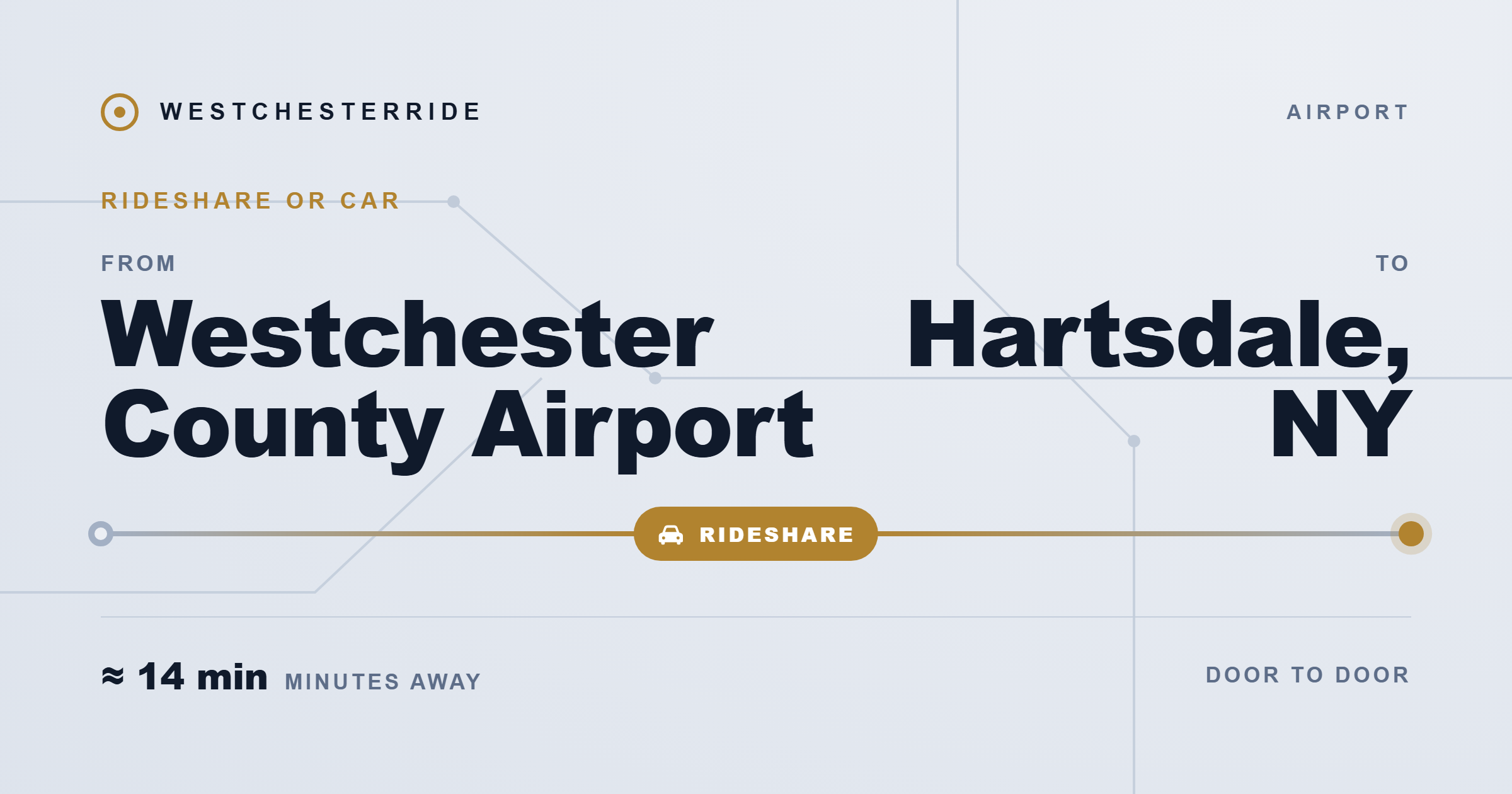
HPN to Hartsdale is only 8 to 9 miles, and the trip is not long so much as inefficient. Westchester County Airport sits north of the county’s transit core; Hartsdale sits south of it; and the county’s hub-and-spoke network, built around White Plains, forces almost every non-car option to detour through that single hub before doubling back. The result is a short lateral hop that the system treats like a two-leg journey, where a taxi covers it in 15 minutes but transit needs an hour or more through a station you did not want to visit. This is the hub-and-spoke tax on lateral movement, and it is why closeness here does not translate into connectivity. This guide explains why the route feels indirect, what each option really costs in time, and how the last mile inside Hartsdale changes the answer.
Quick answer
- Most practical: A taxi or rideshare, 14 to 20 minutes, with no detour and no transfer.
- Cheapest: Bus plus train through White Plains, $9 to $13, but 45 to 90 minutes with a forced connection.
- Why it is indirect: The hub-and-spoke network routes lateral trips through White Plains, even short ones.
- The rule: Closeness is not connectivity here, so a nearby trip can still be an inefficient one.
| Mode | Price | Travel time | Best for |
|---|---|---|---|
| Taxi | No published fare, prearranged | 14-20 min | Predictable arrivals, luggage |
| Rideshare (Uber/Lyft) | No published fare | 15-20 min | Flexible, app-based |
| Bus + train (via White Plains) | $9-$13 | 45-90 min | Budget, flexible time |
| Bus + bus | ~$6 | 60-100 min | Cost-first trips |
| Private car service | Quoted at booking | 14-20 min | Corporate, scheduled |
Fares and travel times on this page are 2026 estimates and can change with the season, schedule updates, demand, weather, and service conditions. Confirm current prices and times with the official carrier before you travel.
Prices are reference bands; the White Plains detour and transfer timing move every figure.
Understanding the hub-and-spoke penalty
The route is a textbook case of suburban proximity failing to become functional connectivity. HPN sits north of the county’s primary employment and transit core, and Hartsdale lies south of it, so almost every non-car option requires an indirect detour through the middle. The system overview explains the underlying design, and this trip exposes its blind spot: the network is optimized for reaching hubs, not for moving laterally between points near one.
Westchester’s transit runs on a hub-and-spoke model with White Plains as the dominant interchange, which works beautifully for trips to White Plains and creates friction for trips that merely pass nearby. HPN connects to White Plains by a single Bee-Line route; Hartsdale is served by southbound routes optimized for commuter flow toward the Bronx and Manhattan. The result is a forced convergence at White Plains even though Hartsdale is geographically closer than many destinations with simpler trips, and the transportation options overview frames how that convergence shapes the county.
The contrast with nearby routes makes the penalty visible. A trip to HPN to White Plains is a clean single-seat connection because White Plains is the hub itself; a longer trip like HPN to Yonkers feels expectedly complex because the distance prepares you for it. Hartsdale is the frustrating middle case: short enough to expect simplicity, but structured so the system delivers friction instead.
What is the best way to get from HPN to Hartsdale?
The best way to get from HPN to Hartsdale is a taxi or rideshare, about 14 to 20 minutes with no detour or transfer. Public transit is possible but indirect, usually connecting through White Plains for a total of 45 to 90+ minutes, because the hub-and-spoke network routes even this short lateral trip through its hub.
Typical time by option:
Taxi or rideshare:
→ About 15 minutes, direct
Bus plus train via White Plains:
→ 45 to 90+ minutes with a forced transfer
Bus plus bus:
→ 60 to 100 minutes, cheapest and slowest
The options in detail
Taxi and rideshare: the direct answer
For most travelers, a taxi or rideshare is the least ambiguous option because it ignores the hub entirely: door to door in 14 to 20 minutes, picked up at HPN’s ground transportation area. Westchester County Airport publishes no taxi fare of any kind, and it does not allow hailing at the curb: cruising for passengers and hailing an unoccupied taxi are both barred, and arriving passengers are told to call one of the companies licensed by the county Taxi and Limousine Commission directly. It eliminates the last-mile walk, the schedule gaps, and the White Plains detour in one move, and it stays predictable even for evening arrivals when transit thins. The taxi-versus-rideshare comparison sorts which to book.
Edge case: weather and surge. Severe weather reduces driver availability and peak demand brings surge pricing, so a bad-weather arrival is the one time the direct option loses its reliability edge and a booked car earns its premium.
Public transit via White Plains: cheap but indirect
The bus-plus-train route is the most cost-efficient and the most timing-sensitive: Bee-Line Route 12 from HPN to the White Plains TransCenter, a walk to the Metro-North Harlem Line, a train to Hartsdale, and a final walk, for $9 to $13 total. Best case is 45 to 55 minutes, but the common case is 70 to 90, because Route 12’s frequency is limited and not synchronized with flight arrivals, and a missed connection compounds fast. The Metro-North stations guide covers the transfer.
Edge case: early or late flights. Route 12 runs a limited weekday span, so before dawn or late evening the transit chain is not viable, and the Bee-Line bus guide shows why the schedule, not the distance, is the binding constraint.
Bus-only and private car: the two extremes
A bus-only combination, Route 12 plus a Route 20 or 21, avoids the train fare for about $6 but runs 60 to 100 minutes with a transfer, suiting only cost-first trips near Central Park Avenue. At the other end, a private car service quotes a flat price when you book, with flight monitoring and a reservation, which corporate and early-morning travelers use to remove all timing risk, a trade the transit-versus-driving comparison frames.
Edge case: the Hartsdale sibling routes. The same hub logic shapes Hartsdale’s airport trips generally, playing out over longer distances the same way it does on this short one.
The last mile inside Hartsdale
Reaching Hartsdale is only part of the trip, because the town splits sharply by micro-area. East Hartsdale Avenue is denser, more walkable, and closer to the train station; West Hartsdale Avenue is car-oriented with limited sidewalks and higher reliance on pickups. For a traveler with luggage, which side you are headed to can decide whether transit was ever viable, so the destination address matters as much as the mode, which the local Hartsdale guide details.
This is why the same route earns opposite verdicts from different travelers. A light-luggage trip to a walkable East Hartsdale address can make the bus-plus-train chain workable; a bag-laden trip to a West Hartsdale pickup makes the taxi close to mandatory. The last mile, not the airport leg, is often where the decision is actually made.
Local insider tips for this route
Default to the taxi for a short, direct trip
At 8 to 9 miles the ride is quick and the fare modest, so the taxi’s directness usually beats the transit detour’s savings. For most arrivals, especially with luggage or after dark, the 15-minute door-to-door trip is worth paying for against an hour-plus through White Plains.
Price the White Plains detour honestly
The transit fare looks cheap until you add the forced convergence at White Plains and the wait for a poorly synchronized Route 12. Count the whole chain, connection and walk included, before choosing transit, because the hub detour is the real cost, not the ticket.
Match the mode to your Hartsdale address
Decide by which side of Hartsdale you are going to. A walkable East Hartsdale Avenue destination keeps transit in play; a car-oriented West Hartsdale address tilts hard toward a taxi or a booked car, since the last-mile walk there is the trip’s real obstacle.
Do not plan an early or late flight around Route 12
Bee-Line Route 12’s limited weekday span means the transit chain simply is not there before dawn or late evening. For those flights a pre-scheduled car is the safe option, and allowing 30 to 40 minutes with a booked pickup covers an early departure comfortably.
Expect friction the distance does not predict
The short mileage sets up a false expectation of simplicity, so plan for the hub-and-spoke detour rather than the map. Knowing the route is inefficient by design, not by accident, is what keeps it from surprising you at the White Plains transfer.
Common failure scenarios
Expecting simplicity from the short distance:
→ The hub-and-spoke network routes it through White Plains
Pricing transit by fare alone:
→ The forced detour and wait are the real cost
Planning an early or late flight by Route 12:
→ Its limited weekday span leaves no viable chain
Ignoring which side of Hartsdale you are headed to:
→ West Hartsdale’s last mile can defeat transit
Assuming a missed connection is minor:
→ Route 12’s low frequency turns it into hours
Choosing bus-only to save a few dollars:
→ The transfer and headway cost 60 to 100 minutes
Related guides
For the airport end of this route, see the HPN airport guide.
Frequently asked questions
What is the best way to get from HPN to Hartsdale?
A taxi or rideshare, about 14 to 20 minutes, picked up at HPN’s ground transportation area. It is direct, predictable even for evening arrivals, and skips the White Plains detour that transit requires. Public transit is cheaper at $9 to $13 but runs 45 to 90+ minutes through a forced connection, so it suits only budget travelers with time and light luggage.
Why does such a short trip take so long by transit?
Because Westchester’s hub-and-spoke network routes lateral trips through White Plains. HPN connects to the hub by a single bus, and Hartsdale is served by southbound commuter routes, so a transit trip has to converge at White Plains and double back even though Hartsdale is only 8 to 9 miles away. The detour, not the distance, is what stretches the trip past an hour.
Is there a direct bus from HPN to Hartsdale?
No. There is no direct HPN-to-Hartsdale route, because Hartsdale generates outbound commuters rather than inbound airport demand, and transit investment favors dense corridors. Every transit option converges at White Plains first, which is the structural reason the trip feels indirect despite the short distance. For a direct trip, a taxi, rideshare, or private car is the only option.
How early should I leave Hartsdale for a morning flight from HPN?
For early flights, allow 30 to 40 minutes with a pre-scheduled car. Bee-Line Route 12’s limited weekday span means transit is often not running or not frequent enough before peak hours, so a booked car is the reliable choice. The short distance keeps the ride quick, but the buffer covers HPN’s check-in and any early-morning traffic.
Does which part of Hartsdale I am going to matter?
Yes, more than travelers expect. East Hartsdale Avenue is denser, walkable, and near the station, so transit can work; West Hartsdale Avenue is car-oriented with limited sidewalks, so the last-mile walk there often makes a taxi close to mandatory. With luggage especially, your destination micro-area can decide whether public transit was ever a realistic option.
Is public transportation reliable for airport arrivals at night?
No, reliability drops sharply in the evening. Bee-Line Route 12’s frequency falls and the transfer risk rises, so a missed connection can strand you or add a long wait. For night arrivals, a taxi, rideshare, or pre-booked car is the dependable choice, since the transit chain depends on a schedule that thins exactly when flights are still landing.
What this comes down to
HPN to Hartsdale proves that closeness does not equal connectivity. The system works as designed, serving hubs efficiently, but it leaves a short lateral trip dependent on either a car or a detour through White Plains that the 8-mile distance never warns you about. Take the taxi for the direct 15 minutes it buys, price the whole transit chain honestly before choosing it, and let your Hartsdale address, not just the map, pick the mode. Plan for the hub-and-spoke detour rather than the distance, and a route stuck in the county’s planning blind spot becomes a short trip you handled on purpose.