
LaGuardia to Yonkers carries a reputation it does not quite deserve. Yes, the 15 to 17 miles cross the Bronx’s saturated highways, and yes, the worst case runs past 90 minutes. But the typical pattern on this corridor is a quieter truth: outside one four-hour afternoon window, the drive holds a remarkably stable 27-to-35-minute band, making this the most forgiving of the NYC-airport routes into Westchester. The planning problem is therefore narrow and specific: know the 3-to-7 p.m. window, know the game-night variable that sits directly on the route, and know the bus-and-train combination that ignores both. This guide covers all three, with the monitoring data that separates this corridor’s real risks from its inherited reputation.

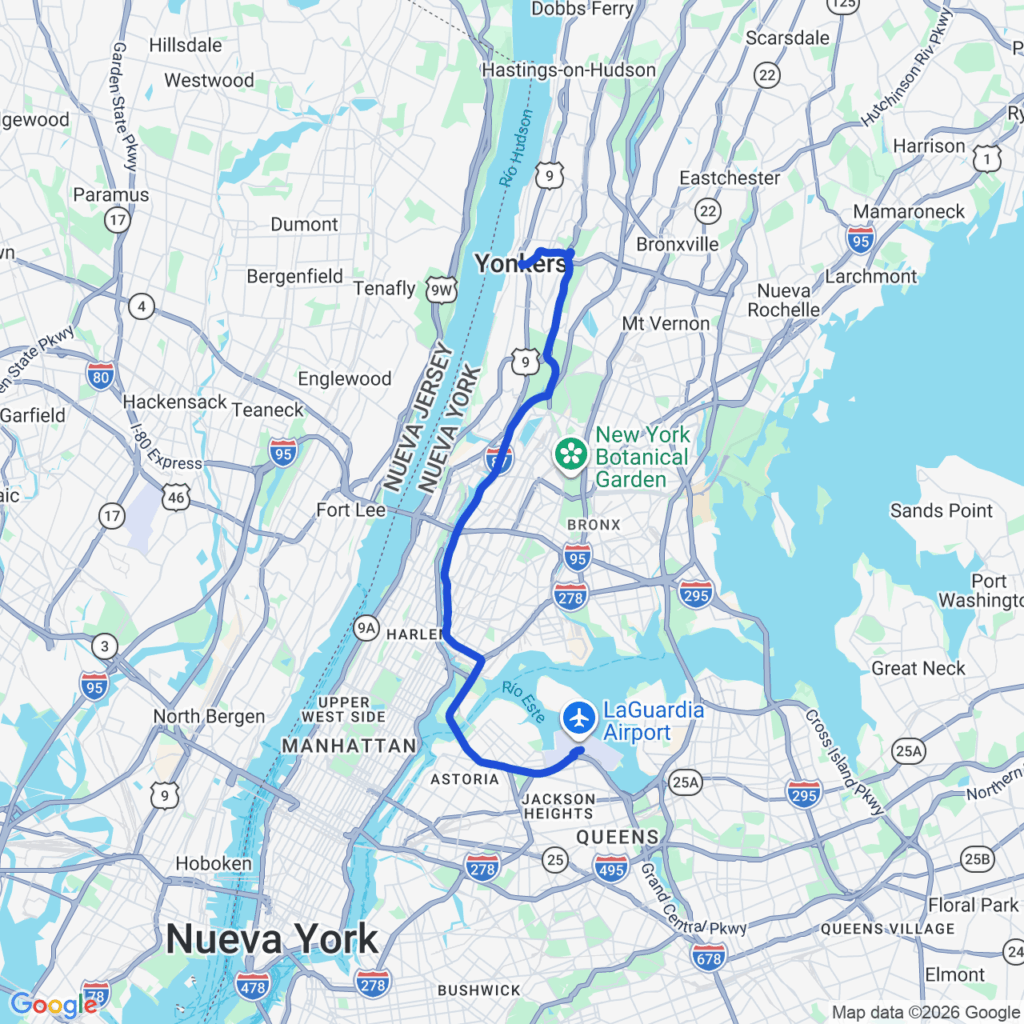
Quick answer
- Most traffic-proof: M60-SBS bus to Harlem-125th, then a Hudson Line train. $13-$19, 60-75 minutes, immune to highways.
- Usually fine: A car outside 3-7 p.m. Monitoring showed 27-35 minute averages most of the day.
- The two traps: The weekday afternoon window, and Yankees home games, which sit right on the Deegan route.
- Late night: Cars only. Transit frequencies thin after midnight.
| Mode | Price | Travel time | Best for |
|---|---|---|---|
| M60-SBS + Hudson Line | $13-$19 | 60-75 min | Peak hours, reliability |
| Uber / Lyft | No published fare | 25-120 min | Off-peak, door to door |
| Taxi (metered) | Meter, no flat fare | 25-120 min | Curb pickup, light traffic |
| Private car service | Quoted at booking | 25-120 min | Families, fixed pricing |
Fares and travel times on this page are 2026 estimates and can change with the season, schedule updates, demand, weather, and service conditions. Confirm current prices and times with the official carrier before you travel.
Prices are reference bands; surge, tolls, and the afternoon window move the car figures.
Understanding the corridor’s real shape
Every road route from LGA to Yonkers threads the same needle: Grand Central Parkway out of the airport, the RFK or Whitestone bridge, then the Major Deegan or the Cross Bronx toward Westchester, highways that run near capacity as a baseline condition. That saturation is why the corridor’s reputation is fearsome, and the county’s airport study confirms the Bronx segment carries essentially all of the variance.
What the reputation misses is the corridor’s shortness. Unlike JFK to Yonkers, which crosses the city’s whole diagonal and stacks its frictions, this route’s exposure window is brief, and the monitoring data below shows the practical result: most hours of most days, the drive simply works.
The two documented exceptions: the weekday 3-to-7 p.m. build, and event nights at Yankee Stadium, which sits directly beside the Deegan and converts game traffic into corridor traffic. Those, plus weather, are the whole risk map.
What is the best way to get from LaGuardia Airport to Yonkers?
The most reliable way from LaGuardia to Yonkers is the M60-SBS bus to Harlem-125th Street plus a Hudson Line train: 13 to 19 dollars and 60 to 75 minutes, immune to highway traffic. Cars run 25 to 35 minutes off-peak.
Typical time by scenario:
By car, most hours of the day:
→ 27-35 minutes
By car, weekday 3-7 p.m. or game nights:
→ 40-90+ minutes
By the bus-and-train combination:
→ 60-75 minutes, hour-independent
The options in detail
The transit combination: immunity at a fixed price
The M60-SBS runs from every LGA terminal to Harlem-125th Street, where northbound Hudson Line trains reach Yonkers in a schedule-reliable hop. The chain costs $13-$19 and delivers 60-75 minutes that no highway incident can touch, which makes it the corridor’s honest answer for exactly the hours the car struggles: weekday afternoons and early evenings.
Its limits are the usual transit ones: a street-level transfer, less comfort with heavy luggage, and thinning late-night frequency. For arrivals landing 4-7 p.m. on a weekday, those costs buy the only trustworthy arrival time available.
Edge case: after midnight, the combination stops being practical; frequencies drop on both legs, and the car options inherit the corridor at its emptiest and fastest.
The cars: good odds, narrow traps
Rideshare, metered taxis and pre-booked services all ride the same odds, and on this corridor the odds are genuinely good: 25-35 minutes at most hours. The pre-booked tier adds flat pricing and flight tracking, the trade the transit versus driving comparison frames county-wide.
The traps are scheduled, not random: the 3-to-7 p.m. weekday window, surge during rain and arrival banks, and Yankees home games flooding the Deegan. A driver’s trick when the Deegan collapses: the Whitestone Bridge plus Hutchinson River Parkway pairing sometimes outperforms it, but only when genuinely clear.
Edge case: game nights. Check the Yankees schedule before booking an evening car; a 7:05 first pitch owns the corridor from 5:30 onward, and the transit combination ignores it entirely.
The arrival: which Yonkers, again
Yonkers spreads far beyond its downtown, and the trip’s final segment depends on the neighborhood: the Hudson Line delivers downtown addresses almost door-to-door from Yonkers station, while northern and eastern neighborhoods add a local leg by car or bus. The local transportation map shows what connects onward.
For car arrivals the neighborhood matters less; for transit arrivals it decides whether the combination lands you home or at a bus stop.
Edge case: transit riders bound for the city’s edges should pre-arrange the station pickup, which keeps the combination’s reliability all the way to the door.
Local insider tips for this arrival
Trust the data’s windows, not the reputation
Before 2 p.m. and after 7 p.m., take the car without ceremony: the monitored band is 27-35 minutes. Between 3 and 7 on weekdays, either accept the 40-plus average with buffer or switch to the transit combination. The corridor punishes exactly one span of hours; the rest of the clock is on your side.
Check the Yankees schedule like a traffic report
The stadium sits on this route’s spine. Evening home games convert the Deegan into event parking from roughly 5:30, and the delay lands on top of whatever the hour already charges. Thirty seconds of schedule-checking is the corridor’s highest-value habit.
Distrust GPS optimism at peak
Navigation ETAs on this corridor consistently underestimate the afternoon window, because the build begins upstream of where the app measures. Peak-hour quotes deserve a 15-to-20-minute skepticism buffer; off-peak quotes are usually honest.
Keep the alternate crossing in reserve
When the Deegan fails outright, the Whitestone-to-Hutchinson pairing is the recovery route, and drivers who know both crossings convert incidents from disasters into detours. When both fail, that is the corridor telling you the transit combination was the answer.
Compare your airports while choosing flights
Yonkers travelers with a choice of arrival airport should weigh this corridor’s stability against the alternatives: the JFK route’s longer diagonal, or HPN’s congestion-free approach from the north. For the reverse trip’s logic, buffers and cutoffs, see the Yonkers to LGA guide, and for LGA from the county’s hub, White Plains to LGA.
What the daily pattern shows
Typical conditions show the corridor’s actual behavior, and the finding was stability. Midnight-to-5 a.m. departures averaged just over 27 minutes; the 5-to-10 a.m. commute window added barely four minutes, averaging 31; midday held at 31. The only sensitive span was 3-to-7 p.m., averaging about 40 minutes with the slowest hours, 3 through 6 p.m., slightly above 41. After 7 p.m., times normalized near 30.
Weekdays averaged 33-34 minutes overall; weekends dropped below 29 and behaved near baseline all day. Even the corridor’s worst monitored hours stayed far below the peaks common on JFK-origin routes, which is the measured basis for this guide’s central claim: the risk here is narrow, scheduled, and avoidable. Figures are multi-day averages and move with weather, incidents, and demand.
Common failure scenarios
Booking a 5 p.m. weekday car with a tight evening:
→ The one window the data says to avoid
Driving into a Yankees home game unknowingly:
→ The stadium sits on the route; check the schedule
Taking the transit combination after midnight:
→ Frequencies thin; the car owns the late corridor
Trusting a 4 p.m. GPS quote of 28 minutes:
→ Peak ETAs underestimate; buffer 15-20 minutes
Ending a transit plan at Yonkers station for a north-side address:
→ The local leg needs its own arrangement
Paying surge in rain when the train was running:
→ Weather charges the road twice; rail once
Related guides
For pre-dawn trips in either direction, the early morning playbook covers the county rules.
Frequently asked questions
How long does LaGuardia to Yonkers really take?
Most hours, 27-35 minutes by car, in typical conditions. The weekday 3-to-7 p.m. window runs longer, and incidents or game traffic can push past 90. The transit combination runs a steady 60-75 minutes at any hour.
What does the trip cost?
The M60-SBS plus Hudson Line combination is the only leg of this trip with a fare published in advance, $13-$19. Rideshare prices in the app at the moment you request the ride, the metered taxi runs on its meter, and a pre-booked car quotes a flat rate when you book. Off-peak, the car’s speed advantage is large; at peak, the transit price buys the only reliable clock.
Is there a train from LaGuardia to Yonkers?
Not directly; LaGuardia has no rail link. The rail-based route is the M60-SBS bus to Harlem-125th Street, then a northbound Hudson Line train to Yonkers, 60-75 minutes total. It is the corridor’s traffic-immune option and the standard answer for weekday afternoon arrivals.
When should I avoid driving this route?
Weekday afternoons from 3 to 7 p.m., Yankees home-game evenings, and heavy rain or snow, which stack surge pricing on top of delay. Outside those windows the monitoring data is reassuring: the corridor held a 27-to-35-minute band across most hours, weekends running smoothest of all.
Is this corridor better or worse than JFK to Yonkers?
Structurally better: it is half the distance, crosses less of the city, and its monitored worst hours stayed far below JFK-route peaks. The trade is LaGuardia’s own limits, no rail link and a smaller airport. For Yonkers households choosing flights, LGA’s ground leg is the calmer half of the equation.
What about late-night arrivals?
After midnight the corridor belongs to cars: transit frequencies thin on both legs, and the highways are at their emptiest, averaging just over 27 minutes in monitoring. Pre-book or use the app at the curb; either way, the late window is this route at its genuine best.
What this comes down to
LaGuardia to Yonkers is the rare New York airport corridor where the data argues for calm: a short hop that holds its baseline most of the day, fails on a published schedule, and offers a traffic-proof alternative for exactly the hours it fails. Plan around the afternoon window, glance at the Yankees calendar, keep the bus-and-train combination in your pocket for peak arrivals, and the Bronx’s reputation stops applying to your trip. The corridor was never the problem; the four o’clock version of it was.





