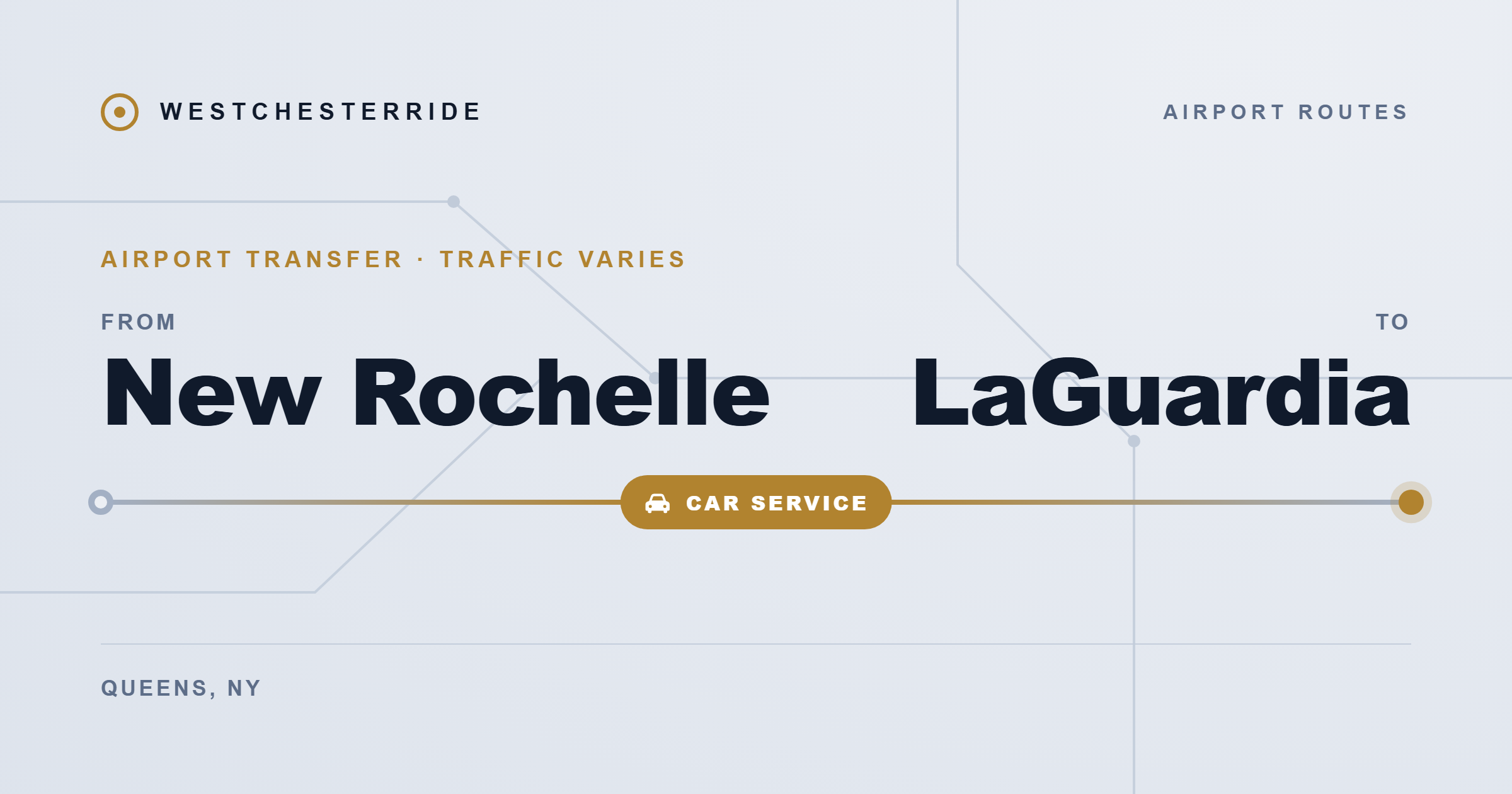
New Rochelle to LaGuardia is a short trip built on a long asymmetry. The 15 to 20 miles split into two segments that behave nothing alike: a Metro-North leg that runs like clockwork, and a surface leg through the Bronx and Queens that answers to traffic, because LaGuardia remains the region’s only major airport with no rail connection. Every plan for this corridor is really a decision about that second segment: how much of it to keep, and how much to pay to remove it. This guide lays the options out as a risk ladder, from the $12 all-transit route to the flat-rate car, with the hybrid move at Harlem-125th Street that keeps the train’s reliability and drop the bus’s volatility.
Quick answer
- Cheapest: Metro-North to Harlem-125th Street plus the M60 SBS bus. $12-$15, 50-75 minutes.
- Fastest: A direct rideshare at early morning or off-peak hours, as little as 30-40 minutes.
- Most reliable: A local taxi or private car on a flat rate. No surge, no transfer, no bus.
- Smartest balance: Train to 125th, then a rideshare for the final hop. The unstable leg disappears.
| Mode | Reference price | Travel time | Best for |
|---|---|---|---|
| Train + M60 SBS | $12-$15 | 50-75 min | Budget, loose schedules |
| Rideshare direct | $50-$90+ | 35-70 min | Early morning, light bags |
| Local taxi | $70-$85 | 40-65 min | Flat-rate predictability |
| Private car service | $80-$120+ | 40-65 min | Families, tight flights |
Fares and travel times on this page are 2026 estimates and can change with the season, schedule updates, demand, weather, and service conditions. Confirm current prices and times with the official carrier before you travel.
Prices are reference bands and move with traffic, demand, and weather.
Understanding the corridor’s split personality
The Metro-North segment is the trip’s solved half: New Rochelle to Harlem-125th Street in a stable 25 to 30 minutes, immune to whatever the Deegan and the RFK Bridge are doing. The county’s system logic rarely shows this cleanly: rail reliability on one side of a transfer, surface volatility on the other.
Everything after the platform is the unsolved half. The 125th Street transfer means stairs, a crowded street, and a bus already operating in mixed traffic; the M60 then crosses the RFK Bridge into Queens corridors where delays stack without warning. The same surface segment is what a direct car spends its whole fare managing.
That is why this corridor rewards thinking in segments rather than modes. The question is not “train or car” but “how much of the surface leg does my flight let me tolerate,” a framing the broader Westchester-to-LGA overview applies county-wide.
What is the best way to get from New Rochelle to LaGuardia airport?
The best way to get from New Rochelle to LaGuardia is Metro-North to Harlem-125th Street plus the M60 SBS bus: about 12 to 15 dollars and 50 to 75 minutes. There is no train to LaGuardia, so tight flights justify a car, and the hybrid train-plus-rideshare removes the least reliable leg.
Typical total time by choice:
By train plus M60, connections clean:
→ 50 minutes best case, 60-75 typical
By direct rideshare, off-peak:
→ 35-40 minutes
Any option at peak or in rain:
→ 75-90+ minutes; plan by the worst case
The options, rung by rung
Train plus M60: the $12 route with a volatile tail
The all-transit route works exactly as designed when nothing intervenes: 25-30 stable minutes to 125th Street, then the M60 SBS direct to the terminals. Its weaknesses cluster in the tail. The transfer is a physical event with luggage, the bus boards slowly because half its riders carry bags, and the ride absorbs whatever the bridge and Queens corridors are doing that hour.
Then comes the loop: inside the airport, the bus circulates the terminals, and Terminal A often lands last. Travelers routinely spend 15-20 extra minutes after entering airport grounds, and 20-30 minute losses in the loop are common enough to plan for.
Edge case: tight flights. The M60’s variance is fine for a loose afternoon departure and wrong for anything you cannot afford to miss.
Direct car: rideshare’s speed, the flat rate’s certainty
A direct rideshare is the corridor’s speed play: 30-40 minutes when roads are clear, averaging around $60 and exceeding $90 in rain or surge windows. Its risk profile mirrors the roads: excellent early morning and late evening, volatile at peaks, and the taxi versus rideshare split decides which counter to book from.
Local taxis and car services trade a little price for a lot of certainty: flat rates near $70-$85 and $80-$120 respectively, drivers who know the corridor’s patterns, and no surge exposure. For families and non-refundable flights, that certainty is the product, the same calculus as on Yonkers to LGA.
Edge case: weekday rush with a fixed departure. At 5 p.m. on a Friday, even the car is a gamble; only the buffer saves you.
The hybrid: train to 125th, car to the terminal
The overlooked move: ride Metro-North to Harlem-125th Street, then request a rideshare for the short hop to LaGuardia instead of boarding the M60. The train leg keeps its clockwork reliability, the volatile bus leg disappears, and the car portion shrinks to a fraction of the full-fare distance, usually landing the total cost between the transit and rideshare extremes.
The pattern generalizes: combining a rail spine with a short surface hop beats one long surface trip whenever traffic is uncertain, the same logic that longer corridors like White Plains to JFK reward.
Edge case: rain. Wet days amplify road delays and surge simultaneously, which squeezes the hybrid’s car leg too. On those days, the flat-rate taxi from home wins outright.
Local insider tips for this departure
Size the buffer to the flight, not the average
Plan to reach LaGuardia at least 90 minutes before you need to be there, and add more at peaks or in rain. The corridor’s averages flatter it; its bad days do not. A missed international connection costs more than every car fare on this page combined.
Respect the 125th Street transfer physically
The connection is stairs, sidewalk, and a busy street, not a station corridor. With one carry-on it is a five-minute walk; with a family’s luggage it is the trip’s hardest segment. Pack for the transfer you are actually making, or remove it with the hybrid.
Know the peak windows cold
Morning peak runs 6:00 to 10:00 a.m., evening 4:00 to 8:00 p.m., and Friday afternoons defy prediction entirely. Inside those windows, move your decision up one rung on the ladder: transit riders go hybrid, hybrid riders go flat-rate, and everyone adds buffer.
Count the terminal loop in your math
Reaching airport grounds is not reaching your terminal. The M60 circulates, Terminal A often comes last, and 15-30 minutes can evaporate inside the fence. Car options drop you at your terminal’s curb, which is part of what the fare buys.
There is no train to LaGuardia
The corridor’s most expensive assumption. Every route, at every price, ends in a bus or car, and plans that ignore this discover it at 125th Street with a boarding pass. The arrival-direction guide shows the same constraint in reverse; the airport rail connections guide shows how LGA compares with the rail-served alternatives.
Common failure scenarios
Trusting the M60 with a tight flight at rush hour:
→ The one leg you cannot schedule is the one that decides
Forgetting the terminal loop:
→ 15-30 minutes inside airport grounds, after “arriving”
Requesting a rideshare in the rain:
→ Delays and surge pricing arrive together
Carrying a family’s luggage through the 125th transfer:
→ Stairs and a crowded street; the hybrid exists for this
Leaving 90 minutes total instead of 90 plus the ride:
→ The buffer starts at the terminal, not at your door
Assuming a train reaches the airport:
→ No rail serves LaGuardia; the last leg is always surface
Related guides
For station access and local connections on the New Rochelle side, see the transportation hub guide, and for the wider mode decision, the transit versus driving comparison.
Frequently asked questions
How do I get from New Rochelle to LaGuardia by public transit?
Metro-North from New Rochelle to Harlem-125th Street, about 25 to 30 minutes, then the M60 SBS bus across the RFK Bridge directly to the terminals. Total cost runs $12 to $15 and total time 50 to 75 minutes, stretching past 90 at peaks or in bad weather.
How much does the trip cost by car?
Reference bands: rideshare averages around $60 and spans $50 to $90 or more in surge windows; local taxis run $70 to $85 on flat rates; private car services $80 to $120 depending on vehicle. The hybrid, train plus a short rideshare from 125th Street, usually lands between transit and full rideshare fares.
Is there a direct train to LaGuardia?
No. LaGuardia is the region’s only major airport without rail service, so every route ends in a bus or car segment. That final surface leg is where the corridor’s delays concentrate, and it is the reason tight schedules justify paying to shorten or remove it.
Is the M60 bus reliable enough for a flight?
For loose schedules, yes: it runs frequently and reaches every terminal. For tight flights, no: it operates in mixed traffic, boards slowly with luggage, and circulates the terminal loop, where Terminal A often comes last. Its variance, not its average, is what a boarding time cares about.
What is the fastest option?
A direct rideshare at early morning or off-peak hours, which can cover the trip in 30 to 40 minutes. At peak hours the advantage narrows and pricing rises, which is when the hybrid or a flat-rate car service becomes the faster bet in practice.
How early should I leave New Rochelle for a LaGuardia flight?
Work backward: your airline’s recommended arrival, plus at least 90 minutes of corridor buffer, plus extra for peak windows (6-10 a.m., 4-8 p.m.), Fridays, and rain. Travelers on the all-transit route should budget the worst case, 90-plus minutes of travel, not the brochure’s 50.
What this comes down to
This corridor never hides its structure: a train you can set a watch by, welded to a surface leg you cannot. Every option on the ladder is just a different answer to how much of that second leg you keep, from all of it at $12 to none of it at $120. Match the rung to what your flight costs you, respect the transfer and the terminal loop, and the 50-minute version of this trip stops being luck and starts being a plan.