Understanding the route from Newark airport to Mount Vernon
Traveling from Newark Liberty International Airport (EWR) to Mount Vernon looks simple on a map, about 29 miles, but in practice it's one of the most friction-heavy airport corridors serving southern Westchester. The challenge isn't distance; it's the stacking of constraints: a state border crossing, limited Hudson River crossings, fragmented transit agencies, and an urban "last mile" that runs through the Bronx edge.
What amplifies friction here is that no single operator owns the full journey. The trip forces travelers to stitch together systems that were designed to serve Manhattan first, not suburb-to-suburb travel. For residents and recurrent travelers, this turns a routine return into a planning exercise with real time and cost penalties.
And the cost side of that equation has grown more complex since January 2025, when New York City's congestion pricing program launched. Car routes that pass through lower Manhattan now carry an added toll on top of already-elevated Port Authority bridge and tunnel fees, details covered further below.
What is the best way to get from Newark airport to Mount Vernon?
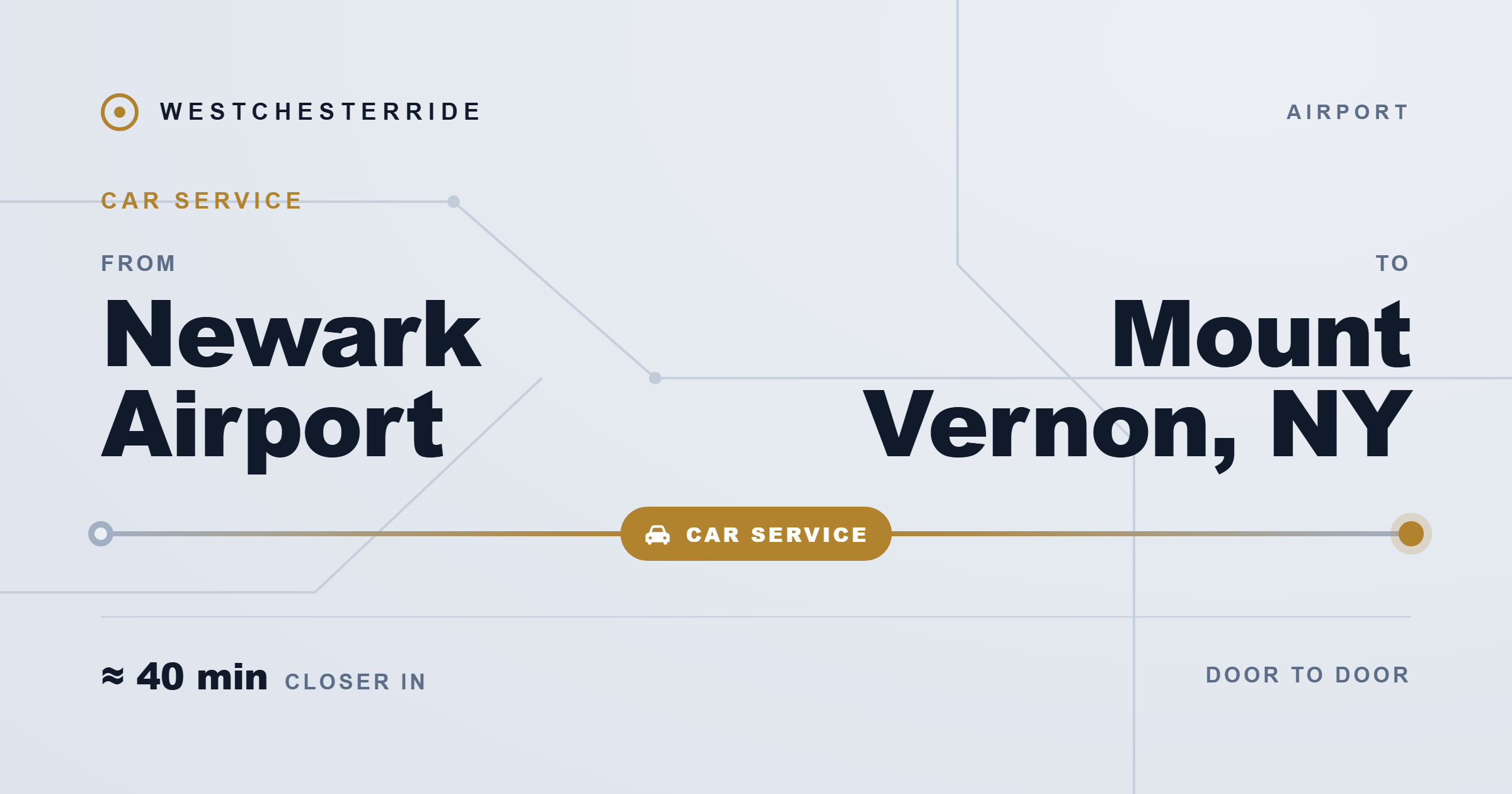
The most reliable option is a rideshare or pre-booked car service, which typically takes 40-65 minutes in light traffic and costs around $60-$160+ (prices are reference only and can change with demand, tolls, and time of day).
Public transportation is cheaper, often $26-$40, but usually takes 1h 45m to 2h+, requires multiple transfers, and becomes fragile with luggage or late arrivals.
In optimal conditions: door-to-door by car can be under 45 minutes. In peak traffic or incidents: travel can exceed 90 minutes, especially when Hudson crossings or Bronx arteries slow down.
The right answer also depends on when you land. A midday arrival on a weekday is a very different calculation than a 10 PM arrival on a Friday, when train frequency drops and rideshare surge pricing can spike simultaneously.
Comparison: train vs taxi vs rideshare vs private car
| Mode | Approx. price* | Typical time | Best for |
|---|---|---|---|
| Train + subway + commuter rail | $26-$40 | 1h 45m-2h 10m | Budget travelers with light luggage |
| Rideshare (Uber/Lyft) | $60-$120+ | 40-75 min | Recurrent travelers, evening arrivals |
| Taxi | $130-$180+ | 40-75 min | Families, heavy luggage, late night |
| Private car service | $140-$200+ | 40-70 min | Time-sensitive trips, predictability |
*All prices are approximate references and may change based on traffic, tolls, and demand.
Detailed transportation options
Option 1: Public transportation (multi-leg)
Typical sequence
- AirTrain EWR to Newark Airport Rail Station
- NJ Transit to Penn Station New York
- Cross Manhattan (walk or subway) to Grand Central Terminal
- Metro-North Railroad to Mount Vernon East or Mount Vernon West/Fleetwood
Breaking down the AirTrain and NJ Transit leg
The first leg starts with the AirTrain, an automated, driverless rail system operated by the Port Authority of NY and NJ that connects all three passenger terminals at EWR with the Newark Airport Rail Station. Allow about 15 minutes to travel via AirTrain between the train station and your airport terminal. The good news on ticketing: when you purchase your NJ Transit ticket to or from Newark Airport through the NJ Transit Mobile App, web ticketing, or ticket vending machines, the AirTrain access fee ($8.75) is already included in the price. If you board without a pre-purchased ticket, upon arrival at the airport station you will be required to pay the $8.75 access fee, which can be paid by tapping a contactless payment card or mobile wallet at the faregate.
For train frequency, at least six NJ Transit trains stop every hour at the Newark Liberty International Airport Station between 6 AM and 9 PM on weekdays, and four trains stop every hour between 9 PM and midnight. Trains that stop at the airport are designated with an airplane or "EWR" on departure boards. Not every train on the Northeast Corridor or North Jersey Coast Line stops at the airport station, so double-checking before boarding matters.
One practical note: ridesharing services are not available directly at Newark Liberty International Airport Station; for Uber, Lyft, or taxi services, proceed to Newark Penn Station or North Elizabeth Station, accessible via train services. Rideshares can also be hailed from Parking Garage P4.
If you want to skip the AirTrain fee entirely, there is a workaround some frequent EWR travelers use: the NJ Transit #62 bus runs between Newark Airport and Newark Penn Station in both directions, with a travel time of approximately 20-22 minutes, subject to traffic. The trade-off is that it adds variability and is not ideal with heavy luggage.
The two Mount Vernon stations: a critical distinction
This is where many travelers go wrong. Mount Vernon has two Metro-North stations on two different lines, and choosing the wrong one can add significant time and cost to the end of your trip.
Mount Vernon East is served by the New Haven Line. On the New Haven Line, Mount Vernon East is roughly 27 minutes from Grand Central, with trains departing approximately every 30 minutes. Metro-North operates a train from Grand Central Terminal to Mount Vernon East roughly every 30 minutes, with tickets costing $8-$13 and the journey taking about 26 minutes.
Mount Vernon West and Fleetwood are served by the Harlem Line. Mount Vernon West has two island platforms and three tracks, with the center track able to be served by either platform. Fleetwood, the next stop north, also has two island platforms and three tracks, with a crossover bridge.
The two lines share trackage between Grand Central and the Bronx, then diverge. The New Haven Line and Harlem Line share trackage between Grand Central and Mount Vernon; the two lines split just north of the Harlem Line's Woodlawn station. In practical terms: if you are heading to the eastern side of Mount Vernon, take the New Haven Line to Mount Vernon East. If you are heading to the western side, take the Harlem Line to Mount Vernon West or Fleetwood. Confirm your destination address before boarding at Grand Central.
For fare zone context, Metro-North's zone structure places Grand Central and Harlem-125th Street in Zone 1, while Mount Vernon West, Fleetwood, and Bronxville are in Zone 3 on the Harlem Line. Mount Vernon East on the New Haven Line falls in a comparable zone. Peak fares apply to weekday trains arriving at Grand Central between 6 AM and 10 AM and departing Grand Central between 4 PM and 8 PM; all weekend trains are off-peak regardless of time.
What to know
- Expect at least three transfers and two ticketing systems (NJ Transit rail plus Metro-North).
- The Manhattan crossover between Penn Station and Grand Central is on foot or by subway; allow 20-30 minutes for this leg, especially with bags.
- Available space for luggage on NJ Transit trains is limited.
- If your flight arrives after the Newark Liberty International Airport Station has closed for the evening, you will need to take alternate ground transportation to your final destination.
When this option is not recommended
- Arrivals after roughly 11:30 PM
- Traveling with children, skis, or large bags
- Tight schedules or low tolerance for delays
Option 2: Rideshare (Uber/Lyft)
What to know
- Prices vary widely due to tolls, return-trip surcharges, and congestion pricing when routes touch lower Manhattan.
- Availability is generally good, but waits can spike during weather events or late nights.
- Most car routes from EWR to Mount Vernon use the Lincoln Tunnel or the George Washington Bridge. The route choice matters for your final toll bill, see the congestion pricing section below for specifics.
When this option is not recommended
- Peak rush hours if you are cost-sensitive
- Severe incidents at Hudson crossings (prices and times surge together)
Option 3: Taxi
What to know
- Flat-rate simplicity, but usually the highest baseline cost.
- Newark-specific access fees and tunnel or bridge tolls apply.
- Taxis from EWR typically use the Lincoln Tunnel, adding the Port Authority toll and, depending on the route through Manhattan, potentially the congestion charge.
When this option is not recommended
- Solo travelers prioritizing price over simplicity
Option 4: Private car service
What to know
- Pre-booking adds predictability (flight tracking, meet-and-greet).
- Often competitive with taxis once all surcharges are considered.
- A reputable car service will know which Hudson crossing to use based on real-time traffic, which matters a lot on this corridor.
When this option is not recommended
- Last-minute plans without availability
- Short budgets
Why friction amplifies on this corridor
Geography: All routes funnel through limited Hudson crossings. From EWR, the two realistic options are the Lincoln Tunnel (Midtown Manhattan approach) or the George Washington Bridge (upper Manhattan and Bronx approach). Each has different toll structures and traffic patterns.
Institutions: Airport, rail, subway, and county buses are run by different agencies with separate rules and fares. NJ Transit, the Port Authority, MTA Metro-North, and MTA New York City Transit each operate a piece of this journey.
Operations: Transfers compound delay risk. A 10-minute slip early can cascade into 30-40 minutes later, especially if you miss a Metro-North departure at Grand Central and the next one is 30 minutes out.
Economics: Tolls, airport access fees, and congestion charges stack, especially for cars. The full toll picture for a car from Newark to Mount Vernon now involves multiple layers, covered in the next section.
Congestion pricing and toll costs for car trips
Since January 5, 2025, New York City's congestion pricing program has added a meaningful cost layer to any car trip that enters lower Manhattan. Passenger vehicles entering the Congestion Relief Zone pay $9 during the peak period and $2.25 overnight. The peak period toll rate applies from 5 AM to 9 PM on weekdays, and from 9 AM to 9 PM on weekends.
The congestion zone itself covers Manhattan south of 60th Street. The Congestion Relief Zone includes local streets and avenues in Manhattan south of and including 60th Street, excluding the FDR Drive, West Side Highway/Route 9A, and the Hugh L. Carey Tunnel connections to West Street. Most car routes from EWR to Mount Vernon do not need to enter the congestion zone at all if they use the George Washington Bridge and travel north through the Bronx directly. Drivers who use the Lincoln Tunnel and then navigate surface streets in Manhattan will trigger the charge.
For the Port Authority crossings themselves, costs also rose when congestion pricing launched. Most vehicles now pay $16.06 during peak hours and $14.06 during off-peak hours; these rates apply to drivers crossing into New York via the Lincoln and Holland tunnels, the George Washington, Bayonne, and Goethals bridges, and the Outerbridge Crossing. Port Authority defines peak hours as 6 AM to 10 AM and 4 PM to 8 PM on weekdays, and 11 AM to 9 PM on weekends.
For E-ZPass users taking the Lincoln Tunnel into the congestion zone, there is a partial offset: a credit reduces Congestion Relief Zone tolls for vehicles using a valid E-ZPass and entering during the peak period via one of the four tolled entries including the Lincoln Tunnel and Holland Tunnel; the credit amount is up to $3 for passenger vehicles.
For drivers routing via the George Washington Bridge directly into the Bronx and then south to Mount Vernon, the GWB toll applies but the congestion zone charge does not, since that route stays north of 60th Street the entire way. Drivers using the George Washington Bridge pay both the full bridge toll and the full congestion toll if they subsequently enter the zone, but a driver going GWB to the Bronx to Mount Vernon never enters the zone at all.
The practical upshot: if your rideshare or car service uses the GWB route, you avoid the $9 congestion charge. If it uses the Lincoln Tunnel with a Manhattan surface-street connection, expect that charge plus the $16.06 tunnel toll. Ask your driver or confirm the route in the app before departing EWR.
The MTA is phasing in the toll structure over a six-year period with an initial $9 peak toll for cars, increasing to $12 in 2028 and then $15 in 2031. Budget accordingly for future trips.
Newark to Mount Vernon vs Newark to Yonkers
A useful contrast is Yonkers. While distances are similar, Yonkers benefits from more flexible rail patterns and road alternatives north of the Bronx, which can smooth the final approach. Mount Vernon's border-city density makes the last mile slower and less forgiving. For a deeper comparison, see our related guide on Newark to Yonkers transportation.
The "last mile" inside Mount Vernon
Arriving by train doesn't end the journey. The two Metro-North stations are roughly a mile apart from each other, so your specific destination in Mount Vernon determines which one to use. Mount Vernon West station is about 1,475 yards from Mount Vernon East station, close enough to walk between them in a pinch, but not with luggage.
Local bus service does exist near both stations. Bus lines 42, 52, and 91 stop near Mount Vernon East Metro-North Station. Additional lines serving the broader area include routes 7, 40, 53, 54, and 55. However, late-night frequency on these routes drops sharply, and they are not practical for travelers arriving from the airport after 10 PM with bags.
A short rideshare from either Metro-North station to your final address in Mount Vernon can add $10-$20 and a wait, again, prices are reference only. Late at night, that wait can stretch, increasing dependence on pre-booked options. If your final destination is more than a half-mile from either station, factor in this last-mile cost and time when comparing transit against a direct car service.
Local insider tips for this route
Choose your Hudson crossing deliberately. The GWB route (I-95 north through the Bronx) avoids the congestion zone entirely and is often faster for Mount Vernon-bound trips. The Lincoln Tunnel is faster to Midtown but adds toll complexity and potential congestion charges if the driver uses surface streets.
Avoid Hudson crossings during weekday peaks (7-9 AM, 4-7 PM) when possible. If possible, plan to travel during off-peak hours or on weekends, especially if you are traveling with children; peak hours are weekdays between 7-9 AM and 4-7 PM.
Confirm your Mount Vernon station before boarding at Grand Central. Mount Vernon East is on the New Haven Line; Mount Vernon West and Fleetwood are on the Harlem Line. They serve different parts of the city.
Buy NJ Transit tickets in advance. Purchase round-trip tickets in advance through the NJ Transit Mobile App or web ticketing to avoid lines. The app bundles the AirTrain fee into one ticket, which simplifies the process considerably.
Build a buffer if your flight lands late evening. The final commuter trains from Grand Central to Mount Vernon matter. Missing the last train eliminates public transit as an option for the rest of the night.
Weather and incidents in Manhattan can flip the "best" option in minutes. Check live traffic before committing to a car, and check the MTA's service alerts before committing to transit.
Consider the GWB bypass route for cars. A driver going I-78 east to I-95 north over the GWB and then south through the Bronx to Mount Vernon sidesteps both the Lincoln Tunnel toll and the congestion zone entirely, though it adds mileage. In moderate traffic this can actually be the faster and cheaper car route.
Related guides
We do not operate transportation services.
Frequently asked questions
Is there a direct train from Newark airport to Mount Vernon?
No. The route requires multiple legs and a Manhattan transfer. You take NJ Transit from the airport to Penn Station New York, cross to Grand Central Terminal, and then board a Metro-North train to either Mount Vernon East (New Haven Line) or Mount Vernon West/Fleetwood (Harlem Line).
Which Metro-North station should I use for Mount Vernon?
It depends on your destination within the city. Mount Vernon East (New Haven Line) sits on the eastern side; Mount Vernon West and Fleetwood (Harlem Line) serve the western side. The New Haven Line and Harlem Line share trackage between Grand Central and Mount Vernon, splitting just north of the Harlem Line's Woodlawn station. Check your specific address against both station locations before buying your Metro-North ticket.
How early should I leave Newark to reach Mount Vernon by midnight?
Aim to depart the airport no later than early evening if using public transit. Only four NJ Transit trains stop at the airport station per hour between 9 PM and midnight. Late-night gaps in Metro-North service can remove rail options entirely for the final leg.
Does congestion pricing affect this trip?
Yes, for car routes that enter lower Manhattan. Since January 5, 2025, passenger vehicles entering the Congestion Relief Zone pay $9 during the peak period and $2.25 overnight. Car routes using the George Washington Bridge and traveling directly through the Bronx to Mount Vernon can avoid the zone entirely. Confirm your driver's route before departure.
What does the full public transit trip cost?
The cost stacks across three systems. The NJ Transit leg from EWR (including the bundled AirTrain fee) runs roughly $15-$17 to Penn Station. The subway crosstown transfer adds a standard MTA fare. The Metro-North leg from Grand Central to Mount Vernon (Zone 3 on the Harlem Line, comparable on the New Haven Line) adds another $8-$13 depending on peak vs. off-peak timing. Total out-of-pocket is typically in the $26-$40 range, though exact fares should be confirmed with the MTA fare calculator at fares.mta.info before travel.
Is the AirTrain at EWR always running?
Ongoing EWR AirTrain maintenance work may impact your journey to and from the Newark Liberty International Airport Rail Station. Check the Port Authority and NJ Transit sites for current service alerts before your trip, especially during off-peak hours when maintenance windows are more common.
Related guides
- Newark to White Plains transportation
- Newark to Yonkers transportation
- JFK to Mount Vernon transportation
- Early-morning airport transportation in Westchester
All times and prices are provided for planning context only and may change based on traffic, schedules, and policies.
Fares and travel times on this page are 2026 estimates and can change with the season, schedule updates, demand, weather, and service conditions. Confirm current prices and times with the official carrier before you travel.