Understanding the destination: a regional draw with local access
Cross County Shopping Center is one of the most visited retail destinations in southern Westchester County. It is an open-air shopping mall located at the junction of the NYS Thruway and Cross County Parkway, in the Kimball neighborhood of Yonkers, New York. The mall is managed by Marx Realty and hosts over 100 stores and restaurants, with anchor stores Macy's and Target. Developed by Sol Atlas, Cross County Center opened in 1954 as one of the nation's first open-air shopping destinations.
That history matters for access. A center designed in the mid-20th century for a different era of car ownership now draws shoppers from across Westchester, the Bronx, and parts of northern Manhattan. This creates a structural imbalance: regional demand funneled through local infrastructure. While the center is visible from major highways and benefits from high regional exposure, the final access depends on a limited number of surface streets, ramps, and signalized intersections that were never designed for sustained regional volumes.
That mismatch explains why reaching Cross County often feels more complicated than expected, especially on weekends.
What happens when a destination is regional but access is local?
When a destination draws visitors from a wide geographic area but relies on local-scale road infrastructure, three things typically occur:
Traffic concentrates into a few access points
Small disruptions multiply into long delays
Parking availability becomes time-dependent, not space-dependent
Cross County is a textbook example of this pattern. High-volume segments of I-87 (NYS Thruway) in the Yonkers area handle over 150,000 vehicles daily according to NYSDOT reports. That volume does not disappear on weekends. It shifts in character, from commuter flow to shopping and leisure trips, which changes both the timing and the clustering of arrivals.
Adding another layer of complexity: adjacent to Cross County Center, at 750 Central Park Avenue, is a shopping center called The Mall at Cross County, which hosts a variety of stores including Michaels, Marshalls, T.J. Maxx, HomeGoods, and Micro Center. The two properties share the same road network, meaning a visitor to either destination contributes to the same access pressure on weekends.
Where Cross County sits in the regional road network
The shopping center sits near the junction of two key corridors:
Interstate 87 (I-87 / NYS Thruway) – primary north-south route for regional traffic
Cross County Parkway – east-west connector linking multiple parkways
These highways move large volumes efficiently, until the final exit. At that point, traffic transitions abruptly from high-speed regional flow into local streets governed by traffic lights, short turn lanes, and pedestrian crossings.
Understanding which exit to use matters. Exit 3 on I-87 ties into Central Park Avenue at Vredenburgh Avenue, southwest of the Cross County Center retail complex. Exit 4 comprises a slip ramp onto adjacent Central Park Avenue leading into the cloverleaf interchange with Cross County Parkway. Both exits feed Central Park Avenue, which is the primary surface street serving the mall. When volumes are high, both exits can back up simultaneously, and drivers switching between them do not gain much time.
From the east, the Cross County Parkway provides a direct connection. In conjunction with the renovation of the shopping center, Exit 5 westbound and Exit 5 eastbound of the Cross County Parkway underwent major reconstruction during 2010 and 2011. The two exit ramps were widened and improved with new traffic lights and signage, and traffic can now proceed from the eastbound parkway directly into the shopping center. That improvement helped, but it did not eliminate the bottleneck at the surface-level intersection where parkway ramp traffic merges with Central Park Avenue traffic.
Starting in Spring 2025, the Cross County Parkway has been undergoing a sign replacement project. As part of the project, new mileage-based exit numbers will replace the current sequential-based exit numbers. If you have not driven this corridor recently, expect signage to look different from older navigation screenshots.
This "last-mile compression" is where delays originate.
Access patterns: weekdays vs weekends
Weekdays (Monday-Friday)
On a typical weekday:
Traffic is predictable
Congestion aligns with commute hours (7-9 am, 4-6 pm)
Midday access is generally smooth
Parking availability is high
For someone visiting between late morning and early afternoon, the trip is usually straightforward.
Weekends (especially Saturdays)
Weekends change the entire equation:
Shopping trips replace commuter flow
Visitors arrive in clusters, not evenly spaced
Parking demand peaks between 11 am and 3 pm
Entry queues form at highway exits and mall driveways
Even though the mall has extensive parking, arrival timing matters more than total capacity.
One additional weekend variable worth knowing: weekend evenings and major events at the casino and Yonkers Raceway can create intense localized gridlock on Central Park Avenue. The raceway sits just south of the shopping center, and when a major event is scheduled, the congestion on Central Park Avenue extends further than the mall's own footprint. Checking the Yonkers Raceway calendar before a weekend afternoon visit is a practical step that many visitors overlook.
Quick comparison
| Aspect | Weekday | Weekend |
|---|---|---|
| Access congestion | Low-moderate | High |
| Parking availability | Consistently available | Time-sensitive |
| Time lost near destination | 0-5 min | 10-25 min |
| Stress level | Low | Moderate-high |
Transportation options to Cross County
1. Driving (most common)
Driving is the dominant option for reaching Cross County.
Why it works
Direct access from highways
Free parking (confirmed by the mall's official site)
Practical for families and group shopping
Why it struggles
Entry bottlenecks on busy days
Parking circulation delays during peak hours
Exit congestion mirrors entry congestion
On weekends, the main delay is rarely the highway. It is the final approach and parking search. The center offers more than 80 shops and restaurants in a beautiful outdoor setting, with free parking year-round. Parking options include a garage and private surface lots. The garage, located along the south side near Macy's, fills fastest on Saturday midday. Surface lots toward the Target end of the property tend to have more turnover and are worth checking first if the garage queue looks long.
2. Bus (Bee-Line system)
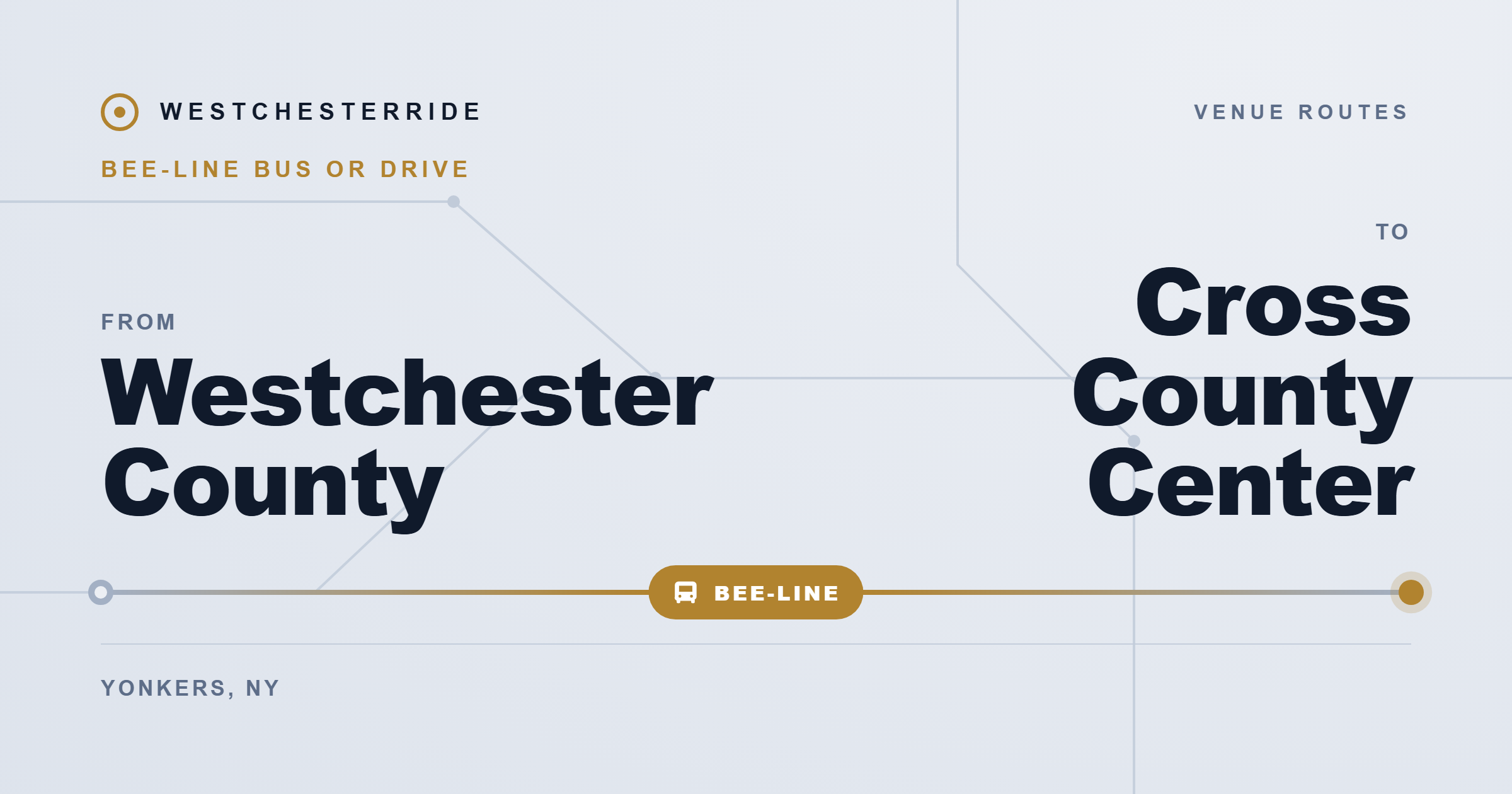
The Bee-Line system, run by the Westchester County Department of Public Works and Transportation, operates roughly 57 bus routes across the region. Several of those routes serve Cross County directly.
Bus lines that stop near Cross County Shopping Center include routes 20, 21, 25, 55, and 7. Here is what each connection looks like in practice:
Route 20 is the workhorse for riders coming from the Bronx. The first stop of the Route 20 bus is Bedford Park Blvd at Jerome Ave, and the last stop is Cross County Center at Macy's. This makes it a direct link between the northern Bronx and the mall entrance, with no transfer required.
Route 25 connects Yonkers more broadly. Route 25 serves Cross County Shopping Center at Xavier Drive, continuing to Ashburton Avenue and the Yonkers Railroad Station on the Hudson Line. That connection to the Yonkers Metro-North station is significant for riders coming from Manhattan who want to avoid driving.
Route 55 provides another Bronx connection. Bus lines 20 and 55 both stop directly at the Cross County Center at Macy's bus stop.
Fares: The standard Bee-Line fare is $3.00 per ride, with a reduced fare of $1.50 for riders 65 and over, certified disabled riders and Medicare card holders, per Westchester County’s Bee-Line fare page, checked October 2026. Pay by tapping a contactless card or phone (OMNY) or with exact cash in coins or $1, $5 and $10 bills; drivers cannot make change, and the MetroCard has not been accepted since July 20, 2026.
Frequency: The Bee-Line system operates buses to Cross County Shopping Center approximately every 30 minutes on several routes, at the $3.00 fare, with journey times from nearby Yonkers points around 24 minutes. Weekend frequency on some routes drops compared to weekday service, so checking the live schedule before you leave is worth the 30 seconds it takes.
Strengths
Useful for nearby residents and Bronx-based visitors
Avoids parking entirely
Low cost
Limitations
Subject to the same road congestion as cars
Lower frequency on weekends for some routes
Less practical for large shopping trips
For short, local visits, buses can work well. For regional visitors, travel time variability increases significantly on busy Saturdays because the buses share Central Park Avenue with all the same car traffic.
3. Metro-North plus bus connection
Visitors coming from Manhattan or points along the Metro-North Harlem Line have a viable two-leg option: Metro-North to a nearby station, then a walk or a short Bee-Line ride to the mall.
Metro-North Railroad train services arrive at Fleetwood station, which is the closest rail stop to Cross County Shopping Center. The nearest train station to Cross County Shopping Center is Fleetwood, which is approximately a 26-minute walk away. That walk is long for most shoppers, but it can be shortened by catching a connecting Bee-Line bus from the Fleetwood station area.
Metro-North Railroad operates trains from Grand Central Terminal to Fleetwood approximately every 30 minutes, with tickets costing $8-13 and the journey taking about 35 minutes.
For visitors who do not want to walk from Fleetwood, the Yonkers Metro-North station on the Hudson Line is another option. From there, Route 25 connects the Yonkers Railroad Station to Cross County Shopping Center at Xavier Drive. This adds a bus leg but keeps the overall trip car-free.
The train-plus-bus combination works best for visitors making a planned day trip who are not carrying large bags. It does not work well for a major household shopping run.
4. Rideshare and taxi
Rideshare services (Uber, Lyft) and taxis are a practical option that many visitors underuse. The drop-off experience at Cross County is straightforward: the open-air layout means drivers can pull close to specific store entrances rather than navigating a covered garage. For visitors coming from nearby Yonkers neighborhoods, a taxi from central Yonkers to Cross County Shopping Center takes approximately 5 minutes and costs $17-21.
The more important rideshare consideration is the return trip. On a busy Saturday afternoon, calling a rideshare from inside the mall while the parking lot is gridlocked means your driver arrives faster than if you had to retrieve your own car from the garage. For visitors who do not need to carry large purchases home, rideshare drop-off and pickup sidesteps the parking circulation problem entirely.
One caution: surge pricing on rideshare apps tends to activate when large volumes of shoppers are all leaving at the same time, roughly between 3 pm and 5 pm on Saturdays. Waiting 15-20 minutes inside the mall before requesting a pickup can reduce both the wait time and the fare.
Common access problems visitors encounter
Congested entrances
High volumes funnel through a small number of driveways. During peak periods, queues often spill back onto surrounding streets. The Central Park Avenue corridor carries the bulk of this load, and the interaction between through traffic, turning vehicles, and pedestrian crossings at the main driveway signals is where most of the visible delay originates.
Parking circulation delays
The mall offers free parking year-round, including surface lots and a multi-level garage. However, when many vehicles arrive at once, drivers may spend 10-15 minutes circulating before finding a spot. The covered garage near Macy's fills earliest. The surface lots near Target and along the outer perimeter of the property typically have more availability even during peak hours, but reaching them requires navigating through the same internal access roads that are congested during peak arrival windows.
Wayfinding challenges
Visitors unfamiliar with the area often report confusion when exiting highways or navigating internal access roads, contributing to sudden lane changes and slowdowns. The ongoing sign replacement project on the Cross County Parkway, which began in Spring 2025, is replacing sequential-based exit numbers with new mileage-based exit numbers. If your GPS or navigation app has not updated its map data recently, the exit numbers it displays may not match the new signs on the road. Downloading a fresh map cache before your trip is a simple precaution.
Why Cross County feels "harder than expected" to reach
On paper, the mall is ideally located. In reality, its access reflects mid-20th-century planning serving 21st-century demand.
Key reasons:
The center grew into a regional destination drawing from a wide catchment area
Local streets remained largely unchanged despite decades of retail expansion
Parking is abundant, but arrival timing is concentrated into narrow windows
Public transit access exists but lacks high-frequency regional service
A second retail complex at the same intersection (The Mall at Cross County) adds demand to the same road network
The result is not constant congestion, but predictable friction at predictable times. Understanding that pattern is the most useful thing a visitor can take away.
The open-air factor and weather
One aspect of Cross County that affects the access experience in ways that enclosed malls do not: it is an open-air property. Cross County Center is an open-air shopping mall. That design has real implications for when people visit.
On a clear, mild Saturday in spring or fall, the outdoor layout draws larger crowds than a comparable enclosed mall would see. The pleasant walking environment between stores encourages longer visits and more impulse stops, which extends dwell time and keeps parking spaces occupied longer. That is one reason the 11 am to 3 pm window is so consistently congested on good-weather weekends.
On rainy or cold days, the dynamic reverses. When it rains hard or is icy, walking between stores outside is much less comfortable than walking through a closed mall. Visitor volumes drop noticeably on poor-weather weekends, and parking is typically easy to find. If your shopping list is not weather-sensitive, a gray Saturday morning can be one of the least congested times to visit.
Practical planning tips (based on real patterns)
Best arrival window: before 10:30 am or after 4 pm on weekends
Most reliable days: Tuesday-Thursday
Holiday periods: expect delays regardless of arrival time; the Thanksgiving weekend and the two weeks before Christmas are the most consistently congested periods of the year
Short visits: weekday midday is ideal
Long shopping trips: plan entry early, exit later
Rainy or cold weekends: crowd levels drop significantly at this open-air property; conditions that deter visitors are conditions that make parking easy
Raceway event days: check the Yonkers Raceway schedule before a weekend afternoon visit; events there add measurable pressure to Central Park Avenue
Exit strategy: when leaving on a busy day, exiting toward the Cross County Parkway rather than back onto Central Park Avenue is often faster, especially if you are heading east or north
Navigation apps: re-download map data before visiting if you have not driven the Cross County Parkway recently, given the ongoing exit number changes
Understanding when demand peaks matters more than choosing a different route.
How this compares to other Westchester destinations
The access pattern at Cross County contrasts with destinations that have:
Distributed entry points
Direct highway-to-parking connections
Strong rail integration
Cross County sits in a middle position. It has better highway access than most local strip centers, but it lacks the kind of direct garage-from-highway connection that newer suburban retail developments have built. Its transit access is real but requires a transfer for most visitors who do not live along Central Park Avenue.
You can see similar dynamics discussed in:
These comparisons help explain why some places feel easier to reach, even when they are farther away.
Related guides
Our role is to provide context, explain patterns, and reduce uncertainty so visitors can plan more effectively.
Frequently asked questions
Is Cross County always congested?
No. Congestion is time-dependent, not constant. Weekday mid-day access is usually smooth. Rainy or cold weekends are also significantly lighter than clear, mild ones.
Which Bee-Line bus routes serve Cross County?
Routes 20, 21, 25, 55, and 7 all stop near Cross County Shopping Center. Route 20 connects directly from the northern Bronx (Bedford Park area). Route 25 connects from central Yonkers and the Yonkers Metro-North station.
Is parking ever unavailable?
Total parking capacity is large, and parking is free year-round. However, during peak windows, finding a spot may take additional time. The garage near Macy's fills fastest. Outer surface lots near Target typically have more availability.
Does public transportation avoid traffic delays?
Not entirely. Buses share road conditions with cars, so congestion still affects travel time. The Metro-North to Fleetwood option avoids road traffic for the longer portion of the trip but requires a 26-minute walk or a connecting bus for the final leg.
Is there a "best route" to avoid congestion?
Route choice helps less than arrival timing. Most delays occur after exiting the highway. If you are coming from the east, the Cross County Parkway's direct entry into the shopping center (added during the 2010-2011 reconstruction) can be slightly faster than approaching via Central Park Avenue.
Are the exit numbers on the Cross County Parkway changing?
Yes. Starting in Spring 2025, the Cross County Parkway has been undergoing a sign replacement project that replaces sequential exit numbers with new mileage-based exit numbers. Check that your navigation app is using current map data.
Key takeaway
Cross County Shopping Center is not difficult to reach because it is poorly located. It is challenging because regional demand meets local infrastructure. The center has been drawing shoppers since 1954, and the road network around it has changed far less than the volume of visitors it attracts. Once you understand that dynamic, the experience becomes predictable, manageable, and far less frustrating. Arrive early, leave late, consider the bus if you are coming from the Bronx or central Yonkers, and check the weather forecast before assuming a weekend will be crowded.
Fares and travel times on this page are 2026 estimates and can change with the season, schedule updates, demand, weather, and service conditions. Confirm current prices and times with the official carrier before you travel.