Fares and travel times on this page are 2026 estimates and can change with the season, schedule updates, demand, weather, and service conditions. Confirm current prices and times with the official carrier before you travel.
Understanding the trip from Westchester County airport HPN to JFK
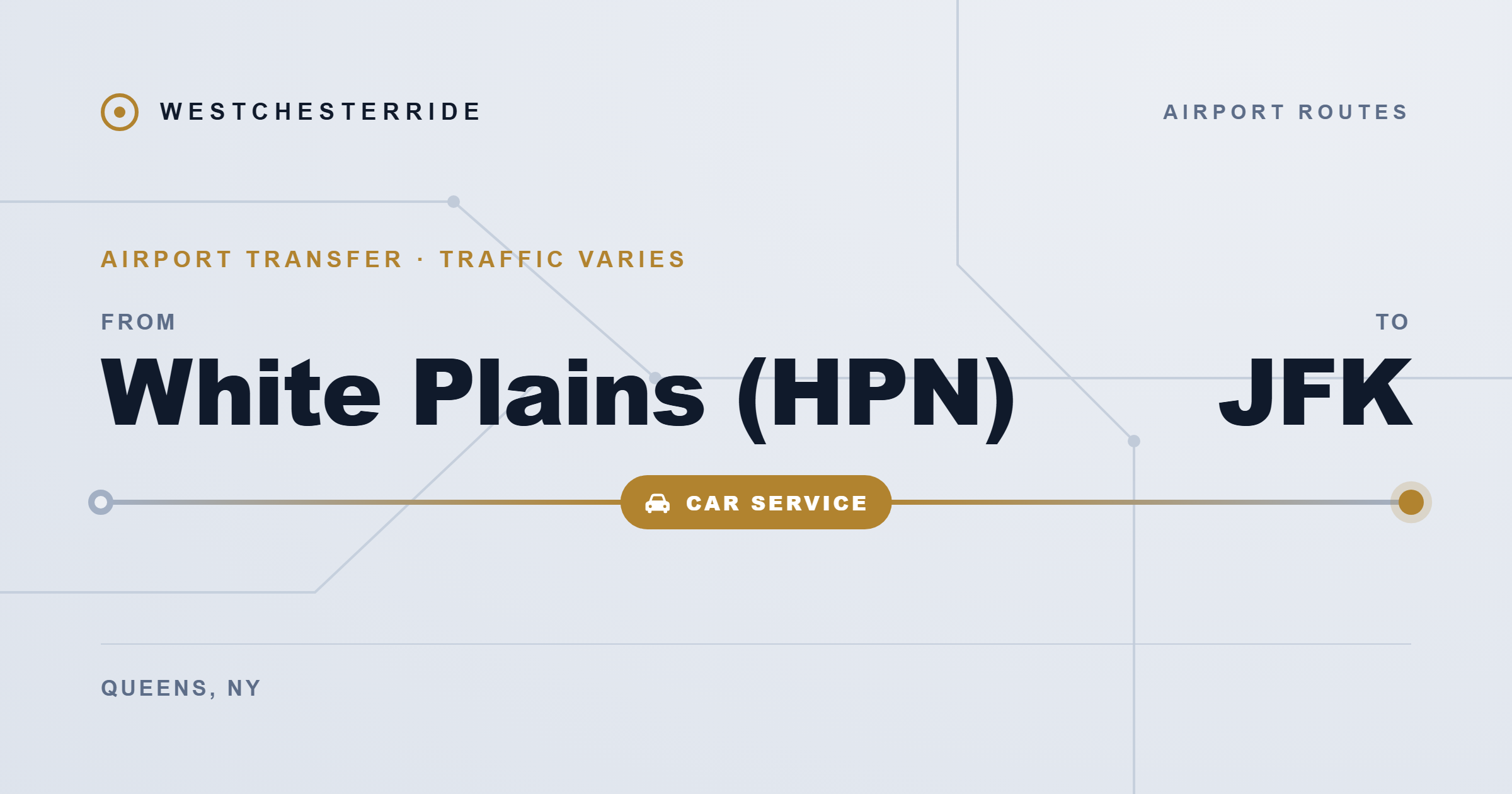
Traveling from Westchester County Airport (HPN) to John F. Kennedy International Airport (JFK) appears simple when looking at a map. The two airports are separated by roughly 38 to 40 miles, which suggests a short transfer across the New York metropolitan region.
In reality, this trip is defined less by distance and more by infrastructure. The route begins in suburban Westchester County, where parkways are relatively calm and predictable. It then transitions into the Queens expressway network, where airport traffic, commuter flows, and construction activity create one of the most volatile travel corridors in the region.
The shift occurs roughly halfway through the journey. The first segment through Westchester and southern Connecticut parkways tends to flow steadily outside peak periods. The second segment, beginning near the Bronx bridge crossings and continuing along the Van Wyck Expressway, is where travel times become unpredictable.
For travelers transferring between these two airports, the route therefore requires planning. Choosing the right transportation option depends on departure time, luggage, traffic exposure, and how much reliability the traveler needs.
Readers unfamiliar with the airport itself may also find useful background context in the Westchester County Airport HPN guide, which explains how the airport fits into the regional aviation system.
Quick answer: best transportation from HPN to JFK
The fastest way to travel from Westchester County Airport to JFK is usually driving, rideshare, or pre-booked car service, which can take about 50 to 70 minutes in light traffic. However, during peak congestion the trip frequently stretches to 90 minutes or more, particularly along the Van Wyck Expressway.
For travelers who want to avoid highway uncertainty entirely, the Metro-North + Long Island Rail Road + AirTrain combination offers a slower but more predictable alternative.
Each option balances cost, convenience, and reliability differently.
Route overview and why this trip is not trivial
The corridor between HPN and JFK effectively combines two very different transportation environments.
The first half of the trip typically runs through the suburban parkway system:
HPN access roads → I-684 south → Hutchinson River Parkway south.
The Hutchinson River Parkway is generally steady outside rush hour. Commercial trucks are prohibited, which helps traffic remain smoother than on many New York highways.
The second half begins after crossing into Queens via the Bronx-Whitestone Bridge or Throgs Neck Bridge. At that point the route feeds directly into the Van Wyck Expressway (I-678), the main highway corridor serving JFK.
Unlike the Hutchinson Parkway, the Van Wyck carries airport traffic, commercial trucks, commuter vehicles, and regional through-traffic simultaneously. Because there is no parallel expressway leading into JFK, congestion on this corridor can cascade quickly.
In addition, JFK is currently undergoing a multi-year redevelopment program that modifies internal airport access roads and terminal approaches. This construction activity adds an additional layer of unpredictability when approaching the airport.
For travelers starting in the White Plains area, the logistics of this corridor are similar to those explained in the White Plains to JFK transportation guide, which examines the same highway system from a nearby starting point.
Critical infrastructure on the HPN to JFK route
Hutchinson River Parkway
The Hutchinson River Parkway connects the White Plains area to the Bronx bridge crossings. Its design predates modern interstate highways and includes tight curves and narrow lanes.
The absence of commercial trucks helps maintain relatively smooth traffic conditions, but the roadway is sensitive to accidents or weather events. Even minor incidents can slow traffic along the southern segments near New Rochelle and Harrison.
Bronx-Whitestone Bridge and Throgs Neck Bridge
Both bridges connect the Bronx to Queens and serve as the primary gateway for Westchester travelers heading toward JFK.
The Bronx-Whitestone Bridge is slightly more direct for airport access and is therefore used more frequently by airport-bound vehicles. The Throgs Neck Bridge sits further east and can sometimes be faster when the Whitestone corridor experiences incidents.
Both bridges use cashless tolling systems, typically costing around $7–$12 depending on payment method.
Van Wyck Expressway
The Van Wyck Expressway is the final highway segment leading directly into JFK.
This is the most critical part of the trip. When congestion builds on the Van Wyck, delays spread quickly because there are no direct alternative highways into the airport.
Peak congestion typically appears during:
• weekday morning commute periods
• weekday afternoon rush hour
• Friday afternoons
• holiday travel periods
Any travel option that relies on roads must pass through this corridor.
Option 1: driving from HPN to JFK
Driving offers the most flexibility in terms of scheduling and departure time. In light traffic the trip can take roughly 50 to 65 minutes.
However, this estimate only holds under favorable conditions, typically late at night or early morning.
During peak travel periods the same drive can easily reach 90 minutes to two hours or more, depending on traffic conditions along the Van Wyck Expressway.
Drivers must also account for:
• bridge tolls when crossing into Queens
• fuel costs
• airport parking if leaving a vehicle at JFK
Even after reaching the airport perimeter, drivers should expect additional time navigating the terminal road system, particularly while construction work continues.
Driving works best when travelers depart very early in the morning before commuter traffic begins.
Option 2: rideshare services (Uber and Lyft)
Rideshare platforms operate at Westchester County Airport and provide direct service to JFK.
Typical price ranges for the trip fall between $110 and $200 depending on vehicle type and demand levels. Surge pricing during peak travel periods can push fares even higher.
Rideshare services work well for travelers who want door-to-door service without scheduling transportation in advance. However, two factors affect reliability on this route.
First, long trips from Westchester into Queens sometimes experience driver cancellations. Drivers may hesitate to accept trips that end far from their original pickup zone.
Second, surge pricing tends to activate precisely when traffic conditions worsen.
For travelers concerned about these factors, reserving a ride in advance can reduce uncertainty.
Option 3: professional car service
A pre-booked car service is often the most reliable transportation option for travelers leaving Westchester for international flights at JFK.
These services operate on fixed pricing agreed upon at the time of booking. Typical costs range between $160 and $260 depending on vehicle type.
The advantages compared with rideshare include:
• fixed pricing without surge
• guaranteed pickup time
• drivers familiar with JFK access roads and construction changes
This option is particularly useful for early-morning departures, where missing a ride could jeopardize a flight.
Travelers planning early flights may also want to review the early morning airport transportation Westchester guide, which explains why pre-scheduled transportation is often the safest choice before sunrise.
Option 4: public transportation
Public transportation between HPN and JFK is possible but requires several transfers.
The typical journey involves four segments.
First, travelers reach the White Plains train station, either by local bus or short rideshare trip.
Second, they take the Metro-North Harlem Line from White Plains to Grand Central Terminal in Manhattan.
Third, passengers transfer to the Long Island Rail Road to reach Jamaica Station in Queens.
Finally, the AirTrain JFK connects Jamaica Station to all airport terminals.
Total travel time usually ranges between 2 hours 15 minutes and nearly 3 hours, depending on transfer timing.
Although the journey is longer than driving, it avoids highway congestion entirely.
For travelers comparing airport access across the region, the broader overview in Westchester County to JFK transportation options provides additional context about how different Westchester locations connect to JFK.
Travel scenarios and recommended options
Different departure times often change which transportation option makes the most sense.
Early morning international flights
Flights departing around 6 AM present the most restrictive conditions.
Public transportation options are limited before dawn, and rideshare availability may be inconsistent in suburban areas.
In this case, a pre-booked car service departing around 2:30–3:00 AM is typically the safest option.
Friday midday departures
Friday afternoons are among the worst travel windows for the Van Wyck Expressway. Traffic congestion often builds earlier than expected.
For these departures, many travelers prefer the Metro-North and AirTrain route, which remains unaffected by road congestion.
Weekday evening flights
Evening departures between 5 PM and 8 PM coincide with peak commuter traffic throughout the New York region.
Travelers using road transportation should allow significant buffer time or consider rail connections instead.
Weekend midday departures
Traffic conditions are often lighter on weekends, making rideshare or driving more practical options.
However, travelers should still allow a reasonable buffer because airport traffic can fluctuate.
For travelers making the return journey after arriving at JFK, the logistics are covered in the complementary JFK to White Plains transportation guide.
Insider tips for this airport transfer
Several practical insights can make the difference between a smooth transfer and a stressful one.
The Van Wyck determines most delays
Traffic incidents on this expressway can quickly add significant time to the journey.
Leave earlier than navigation apps suggest
Travel time estimates on navigation apps often reflect ideal conditions rather than real-world variability.
Expect delays inside the airport perimeter
JFK construction projects occasionally modify internal road patterns and terminal access points.
Consider luggage when choosing transportation
Rail connections involve multiple station transfers. Travelers carrying large luggage often find door-to-door transport easier.
Frequently asked questions
Airlines typically recommend arriving three hours before international departures. When traveling by car from Westchester, leaving about four hours before departure usually provides a safer buffer for traffic delays.
Yes. Travelers can combine a local ride to White Plains station with Metro-North, Long Island Rail Road, and the AirTrain to reach JFK.
Uber and Lyft operate in Westchester, but driver availability and surge pricing can vary depending on demand and traffic conditions.
Driving or rideshare is typically fastest in light traffic, sometimes taking under an hour. However, congestion on the Van Wyck Expressway can significantly extend travel time.
Is there a direct airport shuttle between HPN and JFK?
No. There is currently no direct shuttle connecting the two airports, so travelers must choose between private transportation or the multi-step rail route.