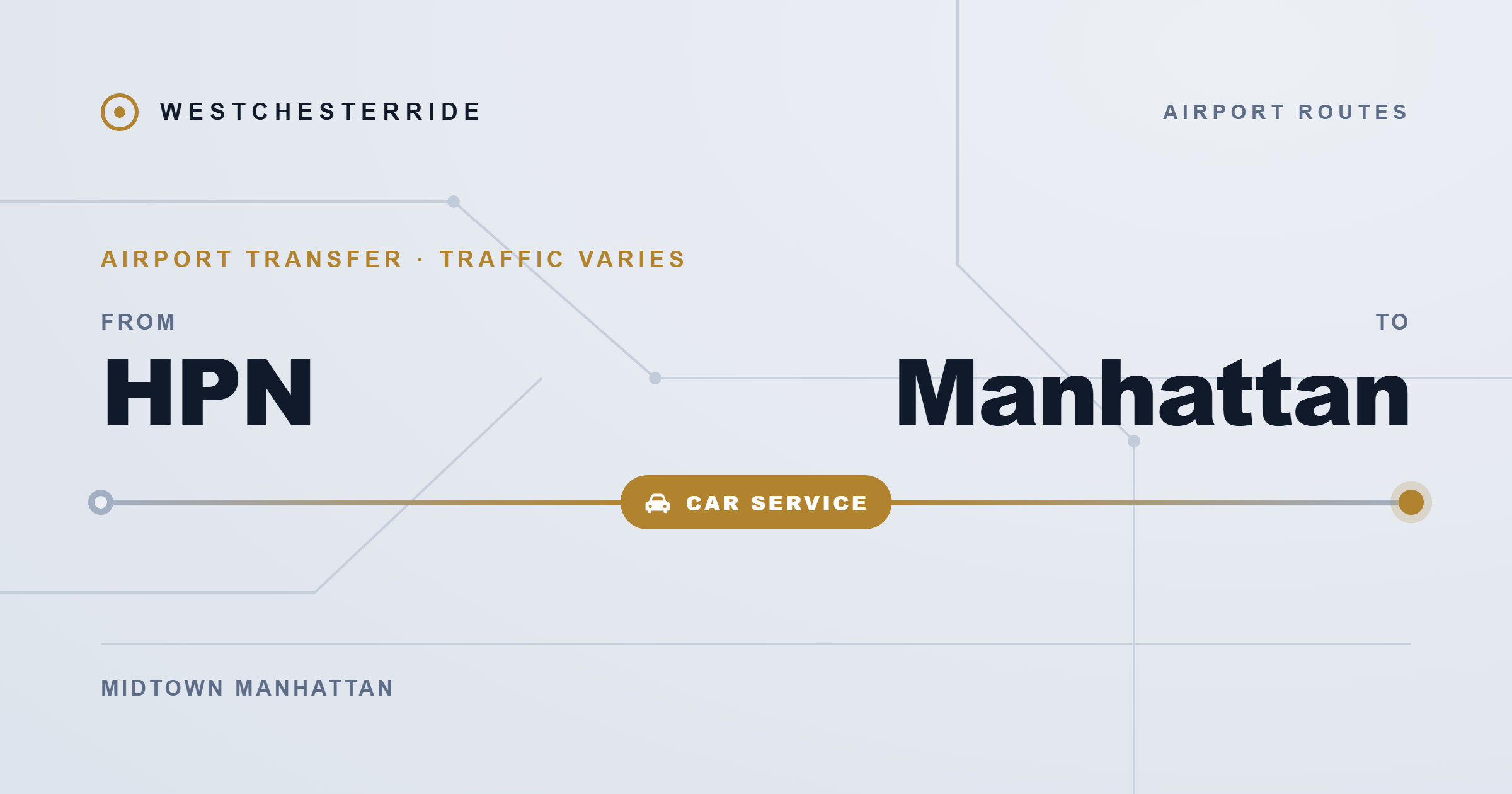
Westchester County Airport has no train station, and it barely matters, because one of the region’s best commuter rail launches sits a 10-to-15-minute car ride away. That fact organizes every HPN-to-Manhattan decision into a single clean choice: ride one seat the whole way, 32 miles down the Hutchinson River Parkway at 45 to 60 minutes and 100 to 275 dollars once congestion pricing loads in, or make the White Plains pivot, a short hop to the station followed by the Harlem Line’s 39-minute express into Grand Central, for roughly a third of the money. Most airports make you choose between convenience and cost; HPN lets you buy each one separately. This guide prices both paths honestly, shows where each wins by hour and destination, and covers the arrival details that decide whether the pivot runs smoothly.
Quick answer
- Best value: The White Plains pivot: car to the station, Harlem Line to Grand Central. About $32-$56 and 75-100 minutes door to door.
- Best one-seat ride: A direct car: 45-60 minutes to Midtown, at a price the app sets when you book and a car service quotes by vehicle.
- Best for business schedules: A booked car service meeting the flight, either direct or to the station.
- Avoid: Improvising at the curb after landing. HPN’s small scale rewards arrangements, not arrivals.
| Option | Time | Reference cost | Best for |
|---|---|---|---|
| Direct rideshare | ~62 min | set in the app | One-seat, door to door |
| Direct car service | 45-60 min | quoted by vehicle | Fixed schedules, luggage |
| Pivot: car + Harlem Line | 75-100 min | $32-$56 total | Value, rush-hour immunity |
| Bee-Line 12 + train | 90-120+ min | under $20 | Strict budgets, loose time |
Fares and travel times on this page are 2026 estimates and can change with the season, schedule updates, demand, weather, and service conditions. Confirm current prices and times with the official carrier before you travel.
Prices are reference bands; congestion pricing and surge move every car figure.
Understanding the corridor’s two paths
The direct path is simple geometry: the Hutchinson River Parkway south, roughly 32 miles to Midtown, with the FDR finishing East Side trips. Off-peak it delivers a genuine 45-minute ride; at rush hour it inherits the parkway’s moods plus Manhattan’s entry queues, and congestion pricing now tolls every drive below 60th Street. The one-seat convenience is real, and so is its price, which neither the app nor the car services publish before the booking screen.
The pivot path exploits the accident of geography that defines this airport: White Plains station sits 10-15 driving minutes away, and from it the Harlem Line reaches Grand Central in 39 minutes on an express, 40-55 in general, at $11.75 off-peak or $16.00 peak one way from White Plains, per the MTA fare table in force since January 2026. Add the short first leg, $20-$40 by app or taxi, and the whole trip lands near $32-$56 with rush-hour immunity the parkway cannot offer.
Which path wins is not a matter of taste; it is a matter of hour, destination, and load, and the airport’s own guide explains the small-airport logistics underneath both.
What is the best way to get from HPN to Manhattan?
The best way from HPN to Manhattan is a two-leg hybrid: a 10-to-15-minute car to White Plains station, then the Harlem Line’s 39-to-55-minute ride to Grand Central, about 32 to 56 dollars total. A direct car runs 45 to 60 minutes and 100 to 275 dollars with congestion charges.
Typical door-to-door time:
By direct car, off-peak:
→ 45-60 minutes
By the White Plains pivot:
→ 75-100 minutes, barely variable
By direct car at peak:
→ 60-90+ minutes, tolls and congestion charge included
The two paths in detail
The direct car: one seat, full price
Rideshare covers the trip in about 62 minutes and publishes no fare in advance; pre-booked car services quote by vehicle and by operator rather than from a published table, buying flight tracking, a named driver, and a wait-through-delays commitment that matters at a small airport. For groups splitting the fare, luggage-heavy arrivals, and West Side or downtown destinations far from Grand Central, the math genuinely favors the one-seat ride.
Its honest weakness is the clock: peak-hour trips inherit the Hutch, the FDR, and the congestion zone all at once, stretching the ride past 90 minutes on bad afternoons while the fare holds or climbs.
Edge case: destinations below 60th Street pay the congestion charge on top of everything; factor it before comparing against the pivot’s flat rail fare.
The White Plains pivot: the value play
The sequence: a taxi or app ride from the terminal, $20-$40 for the 10-15 minute hop covered in detail by the HPN to White Plains guide, then the Harlem Line from a station with dense peak frequency and expresses that touch Grand Central in 39 minutes. Total cost lands near $32-$56, and the rail leg ignores every road variable the direct car must survive.
The pivot’s tax is the connection itself: one transfer, a possible platform wait, and the discipline of checking the schedule before leaving the terminal. Travelers who time the pivot against a specific train convert it into a smooth 75-100 minute trip; travelers who wing it donate 20 minutes to the platform.
Edge case: late evenings, when Harlem Line frequency thins and the first-leg driver pool at HPN does too. After 9 p.m., the direct car’s premium buys real certainty.
The budget chain and the arrival details
A Bee-Line Route 12 bus links the airport to the White Plains TransCenter for a $3.00 Bee-Line fare, per Westchester County in October 2026, making an under-$20 total possible with the train, priced in the route’s thin frequency and a 90-to-120-minute reality. It suits flexible solo travelers and nobody else.
Whatever the path, HPN’s arrival logistics reward one habit: arrange the first vehicle before you land. Westchester County Airport does not allow taxi hailing, so every taxi has to be prearranged, and app supply thins between flight banks, with 30-to-60-minute waits possible late; a booked pickup, direct or to the station, deletes the risk. Budget 30 minutes from touchdown to rolling and enjoy beating it.
Edge case: arrivals between flight banks or after 10 p.m. This is when the curb improvisation fails and the pre-arranged car, at either price point, becomes the only plan that works.
Local insider tips for this corridor
Decide by destination, not just price
Grand Central puts Midtown East in walking range, which makes the pivot nearly door-to-door for East Side addresses. West Side, downtown, and outer-borough destinations add a subway leg to the rail path, and the borough-by-borough logic decides when that added leg tips the math back toward the one-seat car.
Time the pivot against a named train
Check the Harlem Line schedule from the gate, aim the first leg at a specific express, and the connection becomes a five-minute handoff. The pivot’s entire value depends on this one habit; without it, the transfer wait eats the savings’ point.
Book the car before you board
Whether direct or to the station, the pre-arranged pickup is HPN’s core skill: the airport’s smallness makes booked cars fast and improvised ones uncertain. The app-versus-dispatch trade applies at the curb, and the early morning playbook governs the pre-dawn version in both directions.
Respect the peak-hour inversion
Off-peak, the direct car is faster by half an hour; at rush hour, the pivot’s rail leg often wins outright while the parkway crawls. If you land between 4 and 7 p.m. on a weekday, the two-leg trip is not the budget option, it is the fast one.
Run the group math before defaulting
At three or four travelers with luggage, a $195 SUV splits toward the pivot’s per-person cost while deleting the transfer. Solo, the pivot’s savings are decisive. The corridor rewards exactly this thirty-second calculation, the same reliability-versus-cost logic that governs the county’s commutes.
Common failure scenarios
Landing at 5 p.m. and taking the direct car by default:
→ Parkway, FDR, and congestion zone at their worst
Improvising the first leg at the curb:
→ Thin taxi and app supply between banks; book ahead
Making the pivot without checking the schedule:
→ The platform wait quietly eats the savings
Ignoring the congestion charge below 60th Street:
→ It rides on top of every direct-car fare
Taking the budget chain with a deadline:
→ Route 12’s frequency is not built for tight clocks
Booking the pivot at 10:30 p.m.:
→ Thin trains plus thin drivers; the direct car wins late
Related guides
For the system behind this corridor, see how transportation works in Westchester.
Frequently asked questions
How far is HPN from Manhattan?
About 32 miles to Midtown, most directly via the Hutchinson River Parkway with the FDR Drive finishing East Side trips. Off-peak, that converts to a 45-to-60-minute drive; at rush hour, 60 to 90 minutes or more. The distance is fixed; the parkway’s behavior by hour is what actually varies.
How much does HPN to Manhattan cost?
No operator publishes a fare for this trip in advance: rideshare prices in the app at the moment of booking and car services quote by vehicle, with the congestion charge below 60th Street on top of either. The White Plains pivot totals $32-$56: a $20-$40 first leg plus the Harlem Line’s $11.75 to $16.00 one-way fare. The budget bus-and-train chain runs under $20.
Is there a train from Westchester Airport to Manhattan?
Not from the airport itself: HPN has no rail station. The rail option is the pivot: a 10-15 minute car or taxi to White Plains station, then the Harlem Line to Grand Central in 39-55 minutes. It is the corridor’s value play and its most rush-hour-proof route.
How long does the White Plains pivot take door to door?
Plan 75-100 minutes: up to 15 for the first leg, a short connection when timed against a named train, and 39-55 minutes of rail. The figure barely moves with traffic, which is why the pivot often beats the direct car outright during weekday peaks despite the transfer.
When is the direct car worth it?
Off-peak hours, groups splitting the fare, luggage-heavy arrivals, late evenings when trains and drivers both thin, and destinations far from Grand Central’s walking range. A pre-booked service adds flight tracking and a committed pickup, which at a small airport is the difference between rolling in ten minutes and waiting thirty.
What should I arrange before landing at HPN?
The first vehicle, whichever path you choose. HPN’s compact scale means the curb is either quick or empty: the airport does not allow taxi hailing, so taxis must be prearranged, and app supply thins between flight banks and late at night. A booked pickup, plus a glance at the Harlem Line schedule if you are pivoting, converts the whole corridor into a plan.
What this comes down to
HPN’s Manhattan problem has an unusually elegant shape: an airport with no train, ten minutes from a station with excellent ones. Pay for the one-seat ride when the hour is kind, the group is large, or the destination is far from Grand Central; make the White Plains pivot when value or rush-hour certainty matters; and in every case, book the first car before wheels touch. The corridor never forces the choice between fast and cheap. It just asks you to make it on purpose.
Sources
Official pages this guide relies on, checked in October 2026. Rules and prices can change, sometimes for a single event, so confirm with the issuer before you travel.