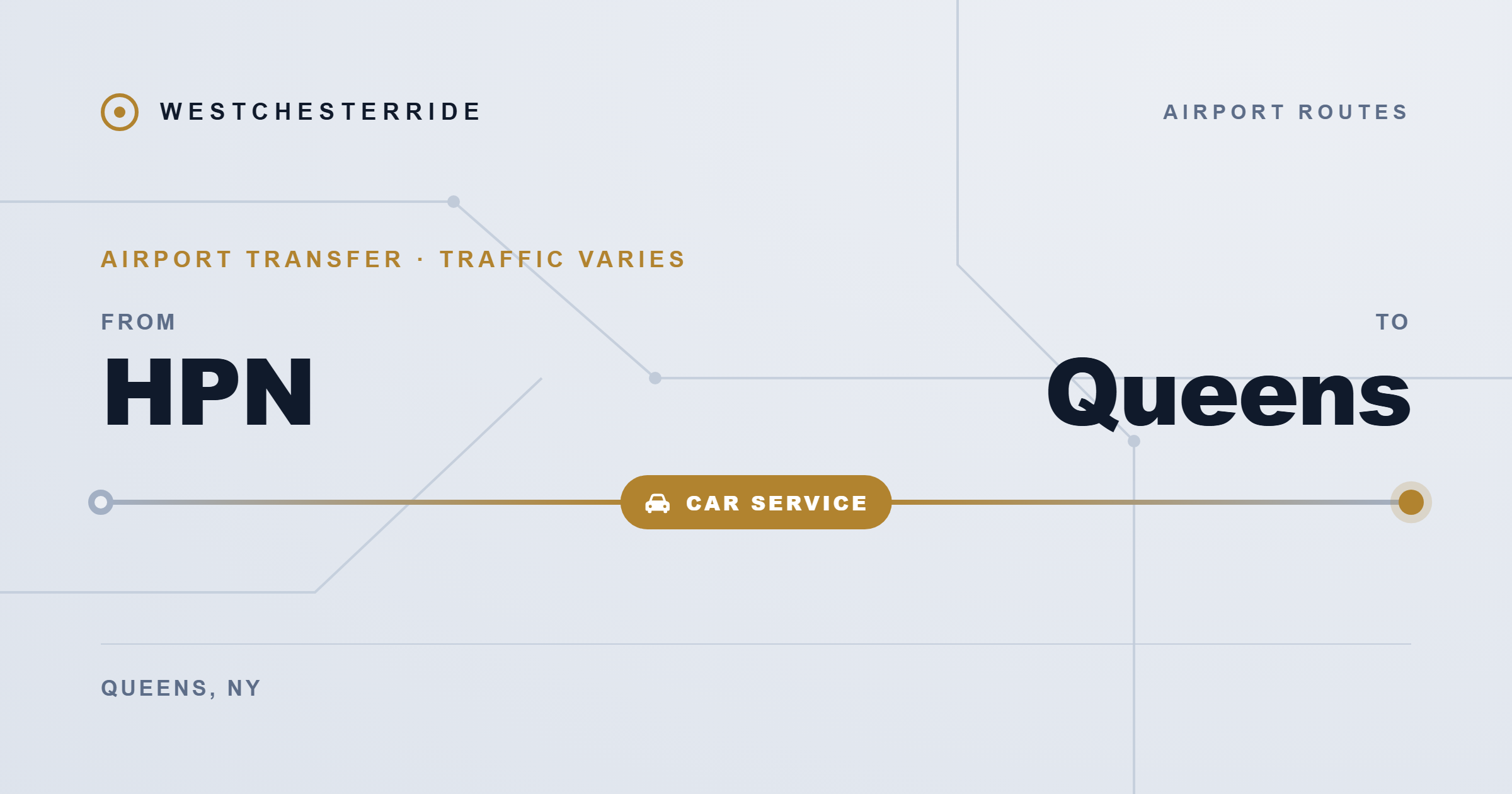
Queens is the borough Westchester’s airport almost touches and never quite reaches simply. The Whitestone Bridge drops HPN traffic straight into its northern edge, 40 to 70 minutes covers most addresses by car, and yet “HPN to Queens” is really three different trips wearing one name: the straight shot to Flushing and the northern neighborhoods, the longer pull to Forest Hills and Jamaica in the borough’s center, and the westward hook to Astoria along the East River. Each sub-area has its own best route, its own rail logic, and its own version of the peak-hour trap. This guide sorts the borough properly: the corridor structure, honest times and costs by destination, and the two trips, JFK and LaGuardia, that look like Queens trips but belong to different playbooks entirely.
Quick answer
- Most of the borough: A direct car via the Hutchinson and the Whitestone Bridge: 40-70 minutes, roughly $96 by app.
- Flushing and Jamaica by rail: Via White Plains and Grand Central, then the 7 train or LIRR: over 2 hours, but traffic-proof.
- Going to JFK or LGA? Those are airport transfers, not borough trips; use their dedicated guides.
- Avoid: The Whitestone approach at weekday peaks, when the bridge queue rewrites every estimate.
| Destination zone | Best route | Time (off-peak) | Reference cost |
|---|---|---|---|
| Northern Queens (Flushing, Whitestone, Bayside) | Hutch + Whitestone Bridge | 40-55 min | ~$96 app, tolls incl. route |
| Central (Forest Hills, Jamaica) | Whitestone + Grand Central Pkwy/Van Wyck | 50-70 min | app fare rises with miles |
| Western (Astoria, LIC) | Hutch + RFK Bridge approach | 45-65 min | similar band |
| Rail alternative | WP station + GCT + 7/LIRR | 2h-2h30 | $40-$60 total |
Fares and travel times on this page are 2026 estimates and can change with the season, schedule updates, demand, weather, and service conditions. Confirm current prices and times with the official carrier before you travel.
Reference figures; peak-hour bridge queues move every road number.
Understanding the three Queens trips
The corridor’s spine is fixed: the Hutchinson River Parkway south from the airport, then the Whitestone Bridge into the borough’s northern edge. From there Queens fans out, and the fan is the decision. Northern destinations, Flushing, Whitestone, Bayside, sit minutes past the bridge, making this the rare New York City trip where a Westchester origin is genuinely convenient. Central destinations add the Grand Central Parkway or Van Wyck legs, inheriting their congestion. Western destinations along the East River often route better over the RFK Bridge, trading the Whitestone entirely.
The rail alternative borrows the White Plains pivot and extends it: the short hop to White Plains station, the Harlem Line to Grand Central, then the 7 train to Flushing or the LIRR from Grand Central Madison toward the borough’s LIRR stops. It is a two-plus-hour project that earns its keep only when peak traffic locks the bridges, the same borough logic the White Plains to NYC guide maps from the county’s hub.
And two trips that look like this corridor are not: flights from JFK belong to the HPN-JFK transfer guide, and LaGuardia connections to the HPN-LGA guide. Airport transfers run on cutoff clocks; borough trips run on neighborhood geometry.
What is the best way to get from HPN to Queens?
The best way from HPN to Queens depends on the neighborhood: a direct car down the Hutchinson to the Whitestone Bridge covers most of the borough in 40 to 70 minutes at roughly 96 dollars by app. Rail via White Plains and Grand Central works for Flushing and Jamaica but takes over two hours.
Typical time by destination zone:
Northern Queens, off-peak:
→ 40-55 minutes
Central and western Queens:
→ 45-70 minutes
Any zone at weekday peak:
→ Add 20-40 minutes for the bridge queues
The trips, zone by zone
Northern Queens: the straight shot
Flushing, Whitestone, and Bayside are this corridor’s natural territory: off the Whitestone Bridge and into the neighborhood within minutes, a 40-55 minute total that makes HPN arrivals genuinely competitive with the city airports for families visiting northern Queens. The app fare averages around $96, tolls riding along, and a pre-booked car adds the usual small-airport advantages: committed pickup, flight tracking, luggage room.
The zone’s calendar quirk: Citi Field and the USTA tennis campus sit at its heart, and event days, Mets games, the US Open’s late-summer fortnight, flood the Grand Central Parkway and the surrounding grid exactly when visitors most want to reach it.
If the trip lands on a tournament day and you plan to drive, the lot-by-lot costs and the hours when parking stops being worth the money are set out in our US Open parking guide.
Edge case: event-day arrivals should aim early or ride rail’s Flushing branch, because the last mile around the stadium grid is where the drive’s advantage dissolves.
Central and western Queens: pick your bridge
Forest Hills, Kew Gardens, and Jamaica extend the trip onto the borough’s central parkways, 50-70 minutes off-peak and the Van Wyck’s moods at peak. Astoria and Long Island City often route better via the RFK Bridge approach, keeping the trip in the 45-65 minute band and avoiding the crosstown crawl.
For these zones the rail alternative gets more interesting: Jamaica and Forest Hills sit on the LIRR’s spine, so the Grand Central Madison connection turns the train chain into a legitimate option for light-bag travelers with loose schedules.
Edge case: trips chaining multiple Queens stops. The borough’s east-west transit is thin; a car, or the dispatch-versus-app choice applied wisely, beats any rail plan for multi-stop days.
The rail chain: the peak-hour insurance policy
The full sequence, car to White Plains station, Harlem Line to Grand Central, then the 7 train from nearby or the LIRR from Madison, totals $40-$60 and 2 to 2.5 hours. As a default it loses to the car everywhere; as peak-hour insurance it quietly wins twice a day, when the Whitestone and RFK queues stretch and the rail chain’s clock does not move.
Its practical sweet spots: Flushing via the 7’s terminus, and the LIRR stops for the borough’s center, both reachable without ever touching a bridge.
Edge case: late evenings invert the logic again; thin train frequencies and empty parkways hand the corridor back to the car at its 40-minute best.
Local insider tips for this corridor
Name your Queens before choosing anything
The borough spans three trip profiles, and the neighborhood decides the route, the time, and whether rail deserves a look. “Queens” is not a destination on this corridor; Flushing, Jamaica, and Astoria are, and each one’s answer differs. Thirty seconds of map-checking beats every other optimization.
Book the airport end, always
Whatever the Queens end looks like, the HPN end rewards the same habit as every trip from this airport: a pre-arranged car meeting the flight, per the airport’s own guide. The curb between flight banks is not a plan, and the early morning rules apply doubly before dawn.
Respect the bridge windows
The Whitestone’s queues build on standard commuter rhythms, and the peak windows add 20-40 minutes to every zone’s figure. Land midday or evening and the borough is close; land at 5 p.m. and the rail chain’s two hours suddenly reads differently.
Check the Flushing calendar in season
Mets home games and the US Open convert northern Queens’ easiest miles into its hardest. On event dates, arrive ahead of the crowd’s window or commit to the 7 train’s terminus, which was built for exactly this surge.
Flying out of a Queens airport? Change guides
The most common “HPN to Queens” trip is really a two-airport transfer, and those run on different math: connection buffers, cutoffs, and committed pickups. The JFK and LaGuardia transfer guides own that territory; this corridor’s rules stop at the terminal doors.
Common failure scenarios
Planning “Queens” without naming the neighborhood:
→ Three trip profiles; the zone decides everything
Crossing the Whitestone at weekday peak:
→ The queue adds 20-40 minutes to any estimate
Driving to Citi Field on a game night:
→ The grid locks; the 7 train was built for this
Treating a JFK connection as a borough trip:
→ Transfers run on cutoff clocks; use the transfer guide
Improvising the HPN curb between flight banks:
→ Thin supply; the booked car is the airport’s one rule
Taking the rail chain with a family’s luggage:
→ Three legs and a subway; the car earns this fare
Frequently asked questions
How long does HPN to Queens take?
By car, 40-55 minutes to northern Queens and 45-70 to the borough’s center and west, off-peak, via the Hutchinson and the Whitestone or RFK bridges. Weekday peaks add 20-40 minutes at the crossings. The rail alternative through White Plains and Grand Central runs 2 to 2.5 hours regardless of traffic.
How much does the trip cost?
App rides average around $96 airport-to-borough, moving with surge and the exact neighborhood; pre-booked cars add their usual premium for a committed pickup. The rail chain totals roughly $40-$60 across its legs. For two or more travelers, the car’s split fare usually settles the comparison.
Is there a train from HPN to Queens?
Not directly; the rail route is a chain: a short car hop to White Plains station, Metro-North to Grand Central, then the 7 train to Flushing or the LIRR from Grand Central Madison to the borough’s center. It works as peak-hour insurance and for light-bag trips to Flushing and Jamaica specifically.
What is the best route to Flushing from HPN?
The Hutchinson River Parkway to the Whitestone Bridge, which lands nearly on Flushing’s doorstep: 40-55 minutes off-peak. On Mets game nights and during the US Open, the surrounding grid congests badly, and arriving ahead of the event window, or switching to the 7 train, protects the trip.
Should I fly into HPN or LaGuardia for a Queens visit?
For northern Queens, HPN is more competitive than travelers expect: a calm small airport plus a 40-55 minute drive against LaGuardia’s in-borough chaos. For central and western Queens, LaGuardia’s proximity usually wins. Flight schedules and fares break most ties; the ground legs are closer than the map implies.
Does this guide cover getting to JFK from HPN?
No, deliberately: JFK and LaGuardia trips are airport-to-airport transfers with their own buffer math, cutoff clocks, and dedicated guides. This corridor covers Queens as a destination, its neighborhoods, events, and homes. The distinction sounds small and changes every number that matters.
What this comes down to
HPN to Queens is three corridors sold under one name, and the trip improves the moment you buy the right one: the Whitestone’s straight shot north, the parkway pull to the center, the RFK hook west. Name the neighborhood, book the airport end, respect the bridge windows and the Flushing calendar, and the borough turns out to sit exactly where the map promises, forty good minutes from the county’s quietest terminal.